
To improve CTR in Google Ads, focus on writing compelling ad copy, utilizing targeted keywords, and optimizing landing pages for relevance and user experience. These strategies directly impact how often users click on your ads, enhancing overall campaign performance.
This topic is crucial for advertisers seeking to maximize their return on investment in digital marketing. A low click-through rate can lead to wasted budget and missed opportunities, making it essential for marketers to grasp the intricacies of ad performance.
This article outlines proven strategies including the creation of engaging ad copy, keyword optimization techniques, and best practices for landing page design, all aimed at driving higher CTR in Google Ads.
What is CTR in Google Ads?
CTR, or Click-Through Rate, is the ratio of users who click on an ad to the number of total users who view the ad. This metric is expressed as a percentage, calculated by dividing the number of clicks by the number of impressions and multiplying by 100. A higher CTR indicates that an ad is effectively engaging its audience, while a lower CTR may suggest a need for optimization.
CTR serves as a key performance indicator in digital advertising. It reflects how well an ad resonates with its target audience and can influence both the ad’s Quality Score and its cost-per-click (CPC). Factors affecting CTR include ad relevance, targeting accuracy, and the effectiveness of ad copy and design. Understanding these components is essential for advertisers seeking to enhance their campaign performance.
- Ad Relevance: Ads that align closely with user search intent tend to achieve higher CTRs.
- Targeting: Precise audience targeting ensures that ads are shown to users most likely to engage.
- Ad Copy and Design: Compelling headlines and visuals can significantly improve click rates.
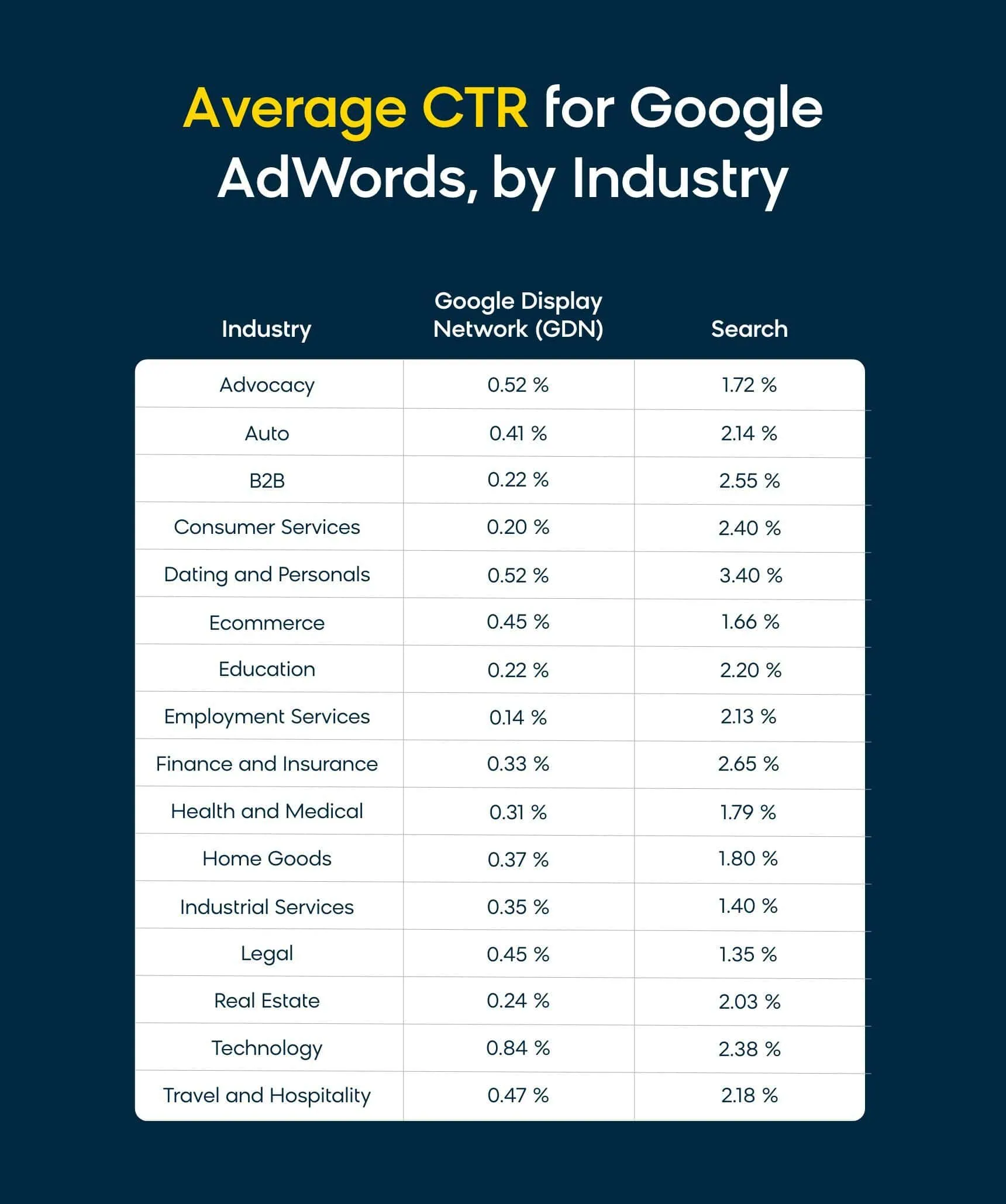
Performance metrics such as CTR can also vary across different industries and campaign types. For example, the average CTR in the retail sector may differ from that in the B2B sector. Therefore, benchmarks should be established based on specific industry standards to assess ad performance accurately.
Expert Tip: To effectively improve CTR, A/B testing of ad variations can provide valuable insights into what resonates best with your audience. Regularly refining ad elements based on data-driven results can lead to sustained improvements in performance.
How can I increase my CTR in Google Ads?
To increase your CTR in Google Ads, focus on optimizing ad copy, using relevant keywords, adjusting targeting settings, and testing different ad formats. Each of these strategies plays a critical role in capturing user attention and driving clicks. Implementing these tactics can lead to substantial improvements in your campaign performance.
- Optimize Ad Copy: Write compelling and relevant ad copy that addresses the user’s needs and includes a strong call to action. Highlight unique selling points to differentiate your ads from competitors.
- Use Relevant Keywords: Conduct thorough keyword research to identify high-performing keywords that align with your target audience’s search intent. Incorporate these keywords into your ad copy and ensure they match the user’s search queries.
- Adjust Targeting Settings: Refine your targeting options to reach the most relevant audience. Consider demographics, interests, and geographic locations to ensure your ads appear to users most likely to engage.
- Test Different Ad Formats: Experiment with various ad formats, such as responsive search ads or display ads, to determine which ones resonate best with your audience. Monitor performance metrics to identify the most effective formats.
Each of these strategies requires careful monitoring and adjustment. Regularly analyze your ad performance data to understand what works and what doesn’t. A/B testing can provide valuable insights into copy and design preferences among your audience.
Expert Tip: Utilize ad extensions, such as site links and callouts, to enhance your ads’ visibility and provide additional information, which can significantly improve CTR by making your ads more informative and appealing.
What are some best practices for improving CTR in Google Ads?
To improve click-through rates (CTR) in Google Ads, focus on creating engaging and relevant ad content that captures attention. Implementing effective strategies can significantly enhance your ad performance and increase user engagement. Below are proven best practices to consider.
First, write clear and compelling headlines. The headline is the first element users see, so it should communicate the core benefit of your offering succinctly. Incorporate relevant keywords to ensure alignment with user search intent, which enhances the relevance score of your ads.
- Use strong calls to action (CTAs): Encourage users to take action by using persuasive language in your CTAs. Phrases like “Get Started,” “Learn More,” or “Shop Now” create urgency and prompt immediate responses.
- Utilize ad extensions: Implement ad extensions to provide additional information, such as location, phone numbers, or additional links. This increases the visibility of your ads and offers users more reasons to click.
- Target specific audiences: Refine your audience targeting to reach users who are more likely to engage with your ads. Use demographic targeting, interests, or past behaviors to tailor your ads to the right people.
- Continuously test and optimize: Regularly A/B test different elements of your ads, including headlines, descriptions, and CTAs. Analyze performance data to determine which variations yield higher CTR and make adjustments accordingly.
These best practices can lead to improved ad relevance and user engagement. Consistently refining and adapting your strategies based on performance metrics is essential for sustained success.
Expert Tip: Leveraging dynamic keyword insertion can personalize ad copy, making it more relevant to user queries. This technique can lead to higher CTR by aligning your ads more closely with what users are searching for.
How does ad position affect CTR in Google Ads?
Ad position significantly influences click-through rate (CTR) in Google Ads. Higher ad positions, typically found at the top of search results, are more visible and generally lead to increased CTR. In contrast, ads placed lower on the page often receive fewer clicks due to reduced visibility.
The correlation between ad position and CTR is primarily due to visibility and user behavior. Ads in the top positions are more likely to be seen first, capturing user attention before they scroll down. Additionally, users often associate higher positions with greater relevance and quality, which further boosts the likelihood of clicks. However, while higher positions usually yield better CTR, factors such as ad relevance, quality score, and bidding strategy also play crucial roles.
- Top Position (1-2): Highest visibility, often resulting in the best CTR. Users tend to trust these ads more.
- Middle Position (3-5): Moderate visibility. CTR declines, but can still be effective, especially with compelling ad copy.
- Bottom Position (6+): Lowest visibility and typically the lowest CTR. Users are less likely to scroll down to view these ads.
Furthermore, ad position can vary based on competition and user intent. In highly competitive industries, even the top positions may see diminished CTR if competitors have highly relevant ads or better offers. Therefore, continuously monitoring ad performance and adjusting bids, keywords, and ad copy is essential to maintain or improve CTR.
Expert Tip: Regularly conduct A/B testing on ad copy and landing pages to identify what resonates best with your audience, as even slight improvements can enhance CTR significantly.
What is a good CTR for Google Ads?
A good CTR for Google Ads typically falls between 2% to 5%, depending on the industry. Some sectors may achieve higher rates, while others may see lower averages. Understanding these benchmarks can help advertisers gauge campaign performance effectively.
For example, in the retail industry, a CTR of 3% is often considered standard. However, in highly competitive markets such as finance or insurance, achieving a 1.5% to 2% CTR may be more realistic. This variance is due to factors such as audience targeting, ad quality, and the nature of the products or services being advertised. Industries with broader appeal tend to have higher CTRs, while niche markets may struggle to capture as much attention.
Additionally, several factors can influence a campaign’s CTR. Ad position, for instance, plays a critical role; ads displayed in the top positions generally receive more clicks. Similarly, the effectiveness of the ad copy and the relevance of keywords can significantly impact user engagement. Advertisers should continuously analyze performance metrics and adjust their strategies accordingly to optimize CTR.
Expert Tip: Regular A/B testing of ad variations can uncover which elements resonate best with the target audience, leading to improved CTR over time. Focus on tailoring messages to the specific interests and pain points of potential customers for maximum impact.
How long does it take to see improvements in CTR after making changes?
Improvements in click-through rate (CTR) can typically be observed within a few days to a few weeks after implementing changes in Google Ads campaigns. The exact timeframe depends on the nature and scale of the adjustments made to the ads, targeting, and keywords.
The speed at which CTR improves largely hinges on the type of modifications implemented. For instance, minor adjustments such as tweaking ad copy or changing the call-to-action may yield quicker results, often within a few days. In contrast, more significant changes, like adjusting targeting parameters or revising bidding strategies, may take longer, generally between one to three weeks. Google Ads requires time to gather sufficient data and optimize performance based on these changes.
Another factor affecting the timing is the existing performance level of the campaign. If a campaign is already well-optimized, changes might lead to more immediate improvements. Conversely, if a campaign is underperforming, it may take longer to see positive shifts in CTR as the system recalibrates itself based on the new inputs. Additionally, seasonal fluctuations and market trends can influence how quickly results are realized, as consumer behavior may vary over time.
Expert Tip: Regularly monitor and analyze performance data to identify which changes yield the best results. This practice allows for a more agile approach to optimization, enabling quicker adjustments that can lead to sustained improvements in CTR.
What factors can negatively impact CTR in Google Ads?
Several factors can adversely affect the click-through rate (CTR) in Google Ads. Irrelevant keywords, poorly crafted ad copy, low-quality landing pages, and high competition are key contributors. Addressing these issues is essential for optimizing ad performance and improving CTR.
First, using irrelevant keywords can lead to misaligned audience targeting. When ads show up for searches that don’t match the user’s intent, they attract fewer clicks. Conduct thorough keyword research and continuously refine your keyword list to ensure alignment with user queries. This will help to enhance the relevance of your ads and improve CTR.
- Craft compelling ad copy: Poorly written ad copy fails to capture attention. Focus on clear, engaging headlines and descriptions that highlight unique selling propositions (USPs) and include strong calls to action (CTAs). A/B testing different ad variations can reveal what resonates best with your audience.
- Ensure high-quality landing pages: If the landing page does not deliver on the promise of the ad, users are likely to bounce. Optimize landing pages for speed, relevance, and user experience. Ensure that the content matches the ad’s messaging and provides value to visitors.
- Evaluate competition: High competition within your niche can drive up costs and decrease visibility. Monitor competitor ads and strategies to identify opportunities for differentiation. Consider adjusting bids or targeting less competitive keywords to improve ad placement and CTR.
Continuously monitoring and adjusting these factors can lead to significant improvements in CTR. Regular analysis of performance metrics allows for data-driven decisions that enhance overall campaign effectiveness.
Expert Tip: Utilize Google Ads’ ad extensions to provide additional information and increase the visibility of your ads. This not only enhances CTR but also improves the overall ad quality score, benefiting your campaigns in the long run.
Advanced Techniques for Enhancing CTR in Google Ads
This section delves into sophisticated strategies designed to significantly boost click-through rates (CTR) in Google Ads. These advanced techniques leverage tools and methodologies that go beyond basic optimizations, ensuring that campaigns resonate effectively with targeted audiences.
Leveraging Ad Extensions
Ad extensions enhance the visibility and utility of Google Ads by providing additional information directly within the ad. By incorporating various types of ad extensions, advertisers can offer more context and options to potential customers, which can lead to higher CTR.
- Sitelink Extensions: Direct users to specific pages on your website, increasing the likelihood of clicks.
- Callout Extensions: Highlight unique selling points, such as free shipping or 24/7 customer support.
- Structured Snippet Extensions: Showcase specific aspects of your products or services, like brands or types.
- Location Extensions: Help users find your business in proximity, driving foot traffic.
Utilizing A/B Testing
A/B testing, or split testing, is a method of comparing two versions of an ad to determine which performs better. This technique allows marketers to refine ad copy, design, and targeting based on real user interactions, ultimately enhancing CTR.
- Define the variable to test, such as headline, description, or call-to-action.
- Create two ad variations, ensuring only one element differs.
- Run both ads simultaneously to gather data on performance metrics.
- Analyze the results to identify which version yields a higher CTR.
Implementing Remarketing Strategies
Remarketing targets users who have previously interacted with your ads or visited your website, providing a second chance to convert. This strategy is effective in re-engaging potential customers who may not have clicked initially.
- Dynamic Remarketing: Show tailored ads featuring products or services users viewed, increasing relevancy.
- Segmented Audiences: Create lists based on user behavior, such as cart abandoners or past purchasers, for targeted messaging.
- Frequency Capping: Limit the number of times users see your ads to avoid ad fatigue and maintain engagement.
Many advertisers overlook the importance of the **ad position** in relation to CTR. A common misconception is that higher ad placement guarantees better performance. While ad position plays a role, relevance and user intent are critical factors that often dictate engagement rates. Ads that resonate with user needs and preferences can achieve high CTRs even in lower positions.
To apply these strategies effectively, consider the following actionable steps:
- Review existing campaigns and identify opportunities to implement ad extensions.
- Set up A/B tests for your top-performing ads to fine-tune messaging and visuals.
- Develop a remarketing plan that targets users based on their interaction history.
By integrating these advanced techniques, advertisers can create more compelling campaigns that boost CTR and drive meaningful engagement with their target audience.
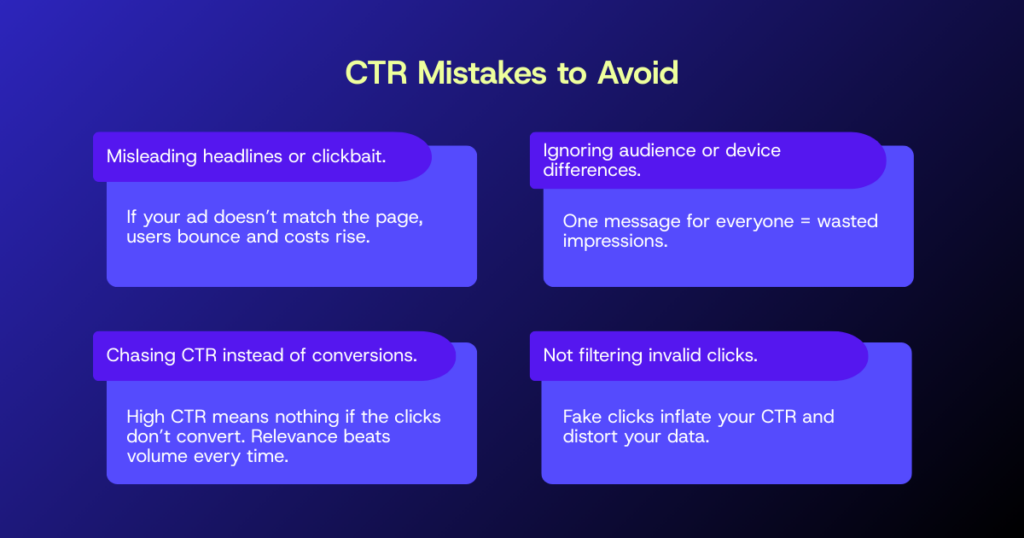
Common Mistakes to Avoid When Trying to Improve CTR
Identifying common pitfalls in Google Ads campaigns is essential for optimizing click-through rates (CTR). Avoiding these mistakes can lead to more targeted traffic and improved ad performance.
Neglecting Negative Keywords
Failing to implement negative keywords can result in irrelevant traffic that drains budget without delivering results. Negative keywords prevent ads from showing for specific terms that do not align with your offerings. For instance, if you sell premium running shoes, adding “cheap” as a negative keyword ensures your ads do not appear for users searching for low-cost options. This strategy refines targeting, leading to higher CTR by attracting a more relevant audience.
Ad Fatigue from Infrequent Updates
Stagnant ad copy can lead to ad fatigue, where users become desensitized to ads they repeatedly see. Regularly updating ad copy keeps content fresh and engaging. Consider A/B testing different headlines and descriptions to determine which variations yield the best CTR. Aim to refresh ad content at least every few weeks, or more frequently if performance metrics indicate declining engagement.
Overlooking Mobile Optimization
With a significant portion of online traffic coming from mobile devices, neglecting mobile optimization can severely impact CTR. Ads that are not optimized for mobile may appear distorted or difficult to interact with, leading to a poor user experience. Ensure that ad formats are responsive and that landing pages load quickly on mobile devices. According to Google, mobile-optimized ads can achieve up to a 20% increase in CTR compared to non-optimized alternatives.
Common Misconceptions
Many advertisers mistakenly believe that higher ad spend alone will improve CTR. While budget plays a role, it is the relevance and quality of the ad that significantly influences click rates. Additionally, not all keywords yield the same results. Long-tail keywords often lead to higher CTR as they target more specific search intents, allowing advertisers to connect with users more effectively.
Expert Insights
One common oversight is focusing solely on CTR without considering the overall conversion rate. A high CTR does not guarantee success if the subsequent conversion rates are low. It is crucial to assess how many clicks lead to desired actions, such as purchases or sign-ups. Balancing CTR with conversion metrics provides a more comprehensive view of ad performance and effectiveness.
Practical Steps to Avoid Mistakes
- Conduct regular keyword audits to identify and add negative keywords.
- Implement a schedule for refreshing ad copy, with A/B testing to gauge effectiveness.
- Ensure all ads and landing pages are mobile-optimized, testing for user experience on various devices.
- Analyze both CTR and conversion rates to measure the true effectiveness of ads.
By avoiding these common mistakes and applying these strategies, advertisers can effectively enhance their CTR in Google Ads, leading to more efficient and profitable campaigns.
Real-World Case Studies: Successful CTR Improvements
This section highlights practical examples of businesses that successfully improved their Click-Through Rates (CTR) in Google Ads. Analyzing these case studies provides actionable insights into effective strategies for enhancing ad performance.
Case Study: Targeted Ad Copy Changes
A leading e-commerce company increased its CTR by 50% by refining its ad copy. The initial ad text was generic and lacked a clear call-to-action. By implementing targeted messaging that resonated with specific customer segments, the company highlighted unique selling propositions (USPs) such as free shipping and limited-time offers. The revised ads included phrases like “Shop New Arrivals with Free Shipping” and featured dynamic keyword insertion to personalize the experience. This strategic shift not only attracted more clicks but also improved conversion rates significantly.
A/B Testing for Effective Headlines
Another successful campaign involved a software company that leveraged A/B testing to identify the most compelling headlines for its Google Ads. The marketing team created two variations for each ad, with one focusing on cost savings and the other on efficiency improvements. Over a month, the company monitored performance metrics and discovered that ads emphasizing efficiency generated a 30% higher CTR. This data-driven approach allowed them to optimize their campaigns continually, ensuring that the most effective headlines were used in real time.
Location-Based Targeting Enhancements
A local restaurant chain improved its CTR by implementing location-based targeting in its Google Ads campaigns. Initially, their ads were displayed to a broad audience, resulting in low engagement rates. By refining their targeting to focus on customers within a 10-mile radius and customizing ad copy to reflect local events and promotions, the restaurant observed a 40% increase in CTR. This approach not only enhanced visibility among potential diners but also fostered a sense of community engagement, resonating well with the target audience.
Nuance: Common Misconceptions in CTR Improvement
Many marketers believe that simply increasing ad spend will lead to higher CTR, but this assumption can be misleading. A higher budget does not guarantee better ad performance; rather, the focus should be on optimizing ad relevance and quality. For instance, well-targeted ads with compelling copy can outperform higher-budget ads that lack these elements. Additionally, neglecting to analyze performance data can lead to missed opportunities for improvement. Always prioritize ad quality and audience alignment over budget alone.
Practical Applications
To replicate these success stories, consider the following actionable steps:
- Conduct a thorough analysis of existing ad copy and identify areas for improvement.
- Implement A/B testing to experiment with different headlines and messaging.
- Utilize location-based targeting to reach a more relevant audience.
- Regularly review performance data to refine strategies and optimize CTR.
By applying these strategies, marketers can significantly enhance their Google Ads performance and achieve better engagement outcomes.
The Role of Landing Page Optimization in CTR
Landing page optimization is a critical factor in enhancing the click-through rate (CTR) of Google Ads. A well-designed landing page not only attracts users but also ensures they have a seamless experience, ultimately boosting conversion rates.

Relevance and User Experience
Relevant landing pages significantly enhance user experience by aligning with the expectations set by ad copy. When users click on an ad, they anticipate finding similar content on the landing page. If the page content deviates from this expectation, users may quickly leave, resulting in a higher bounce rate. Ensuring that landing pages reflect the ad’s promise improves user satisfaction and encourages further engagement.
Best Practices for Landing Page Design
To create landing pages that resonate with ad copy, consider the following best practices:
- Consistent Messaging: The language and tone used in the ad should carry over to the landing page, reinforcing the message.
- Clear Call-to-Action (CTA): CTAs should be prominently displayed and clearly convey what action users should take next.
- Visual Hierarchy: Use headings, subheadings, and bullet points to organize content, making it easy for users to scan.
- Trust Signals: Incorporate testimonials, reviews, or security badges to build credibility and trust.
Loading Speed and Mobile Responsiveness
The speed of a landing page is crucial for user engagement. Research indicates that a one-second delay in loading time can lead to a 7% reduction in conversions. Furthermore, with the increasing use of mobile devices for browsing, ensuring that landing pages are mobile-responsive is essential. A mobile-optimized page adjusts seamlessly to different screen sizes, providing a better user experience and reducing the chances of users abandoning the page.
Nuanced Considerations
Many assume that a high CTR automatically leads to improved conversion rates. However, this is not always the case. A high CTR with low conversions may indicate that the landing page is not aligned with user expectations or that the ad is attracting clicks from uninterested audiences. Additionally, A/B testing different landing page elements can provide insights into what resonates best with the target audience, allowing for continual optimization.
Practical Application
To improve CTR in Google Ads through landing page optimization, implement the following steps:
- Audit existing landing pages for relevance to current ad campaigns.
- Utilize consistent messaging between ads and landing pages.
- Enhance loading speed by optimizing images and minimizing unnecessary scripts.
- Ensure mobile responsiveness by testing pages on various devices.
- Regularly conduct A/B testing to refine elements based on user engagement data.
Frequently Asked Questions
What is CTR in Google Ads?
CTR, or Click-Through Rate, is a metric that measures the percentage of users who click on an ad after seeing it. It is calculated by dividing the number of clicks by the number of impressions.
How can I increase my CTR in Google Ads?
To increase CTR in Google Ads, focus on creating compelling ad copy and using relevant keywords. Additionally, optimizing ad extensions and targeting the right audience can significantly enhance click rates.
What are some best practices for improving CTR in Google Ads?
Best practices for improving CTR include writing clear and engaging headlines, using strong calls to action, and ensuring ad relevance to the target audience. Regularly testing different ad variations can also yield better results.
How does ad position affect CTR in Google Ads?
Ad position plays a critical role in CTR, as ads displayed higher on the search results page generally receive more clicks. Higher visibility leads to increased chances of user interaction with the ad.
What is a good CTR for Google Ads?
A good CTR for Google Ads typically ranges from 2% to 5%, depending on the industry and ad type. However, higher CTRs are often achievable with well-targeted and optimized campaigns.
How long does it take to see improvements in CTR after making changes?
Improvements in CTR can usually be observed within a few days to a couple of weeks after implementing changes. However, it may take longer to see significant results depending on the extent of the adjustments made.
What factors can negatively impact CTR in Google Ads?
Factors that can negatively impact CTR include irrelevant ad copy, poor targeting, and low ad quality scores. Additionally, high competition and lack of ad extensions can also lead to decreased click rates.
Final Thoughts on how to improve ctr in google ads
Improving CTR in Google Ads requires a strategic blend of compelling ad copy, precise targeting, and continuous optimization. By leveraging advanced techniques and learning from real-world case studies, marketers can significantly enhance their ad performance and achieve superior results.
To take immediate action, conduct a comprehensive audit of your existing ad campaigns, focusing on ad copy and targeting parameters, and implement A/B testing to identify the most effective combinations that resonate with your audience.
Elevating your CTR not only boosts visibility but also maximizes your return on investment, underscoring the critical role of effective advertising strategies in today’s competitive digital landscape.
Leave a Reply