

What are google ads for law firms?
Google Ads for law firms is an online advertising platform designed specifically for legal professionals to connect with potential clients. By leveraging this tool, firms can significantly enhance their visibility, as research indicates that 75% of users never scroll past the first page of search results. This targeted approach not only increases client acquisition but also maximizes the return on investment for marketing efforts.
Understanding google ads for law firms is crucial in today’s competitive legal landscape. Legal professionals must grasp the nuances of this advertising platform to effectively reach their target audience and stand out in a saturated market. With the legal services industry projected to reach $1 trillion by 2025, failing to utilize Google Ads can result in lost opportunities and diminished market presence.
Not comprehending Google Ads can lead to significant costs for law firms, including missed revenue streams and wasted marketing budgets. Without an effective online advertising strategy, firms risk falling behind competitors who successfully leverage these tools to capture client interest.
This article provides a comprehensive overview of Google Ads for law firms, covering essential topics such as a comparison of top advertising providers, a detailed cost breakdown, best practices for campaign optimization, and insights into integrating local SEO strategies for maximum impact.
For law firms looking to generate local leads through Google Ads or Local SEO, GMB Ranger LLC offers hands-on campaign management. Specialist Md Tangeer Mehedi personally handles campaign setup and ongoing optimization — with no payment required until the first lead comes in.
What are Google Ads for law firms?
google ads for law firms is an online advertising platform that allows legal practitioners to display targeted advertisements on Google’s search results pages and across its advertising network. This service enables law firms to reach potential clients actively searching for legal services, enhancing visibility and generating leads.
Google Ads operates on a pay-per-click (PPC) model, where advertisers pay each time a user clicks on their ad. Law firms use this tool to promote specific practice areas, such as family law, criminal defense, or personal injury, by creating relevant ad campaigns. Recent statistics indicate that law firms that invest in Google Ads can achieve an average return on investment (ROI) of 200% to 300%, making it a compelling choice for legal marketing.
- Search Ads: Text-based ads that appear at the top of search results for specific keywords.
- Display Ads: Visual banner ads shown on websites within Google’s Display Network, targeting users based on their online behavior.
- Local Services Ads: Ads specifically designed for local businesses, allowing law firms to appear in local search results and connect with nearby clients.
Using Google Ads effectively requires a deep understanding of keyword targeting, ad copywriting, and budget management. Law firms must conduct thorough keyword research to identify terms their potential clients are using. Additionally, compelling ad copy that clearly conveys the firm’s value proposition can significantly impact click-through rates and conversion rates. Ad extensions, such as call buttons or location information, can also enhance visibility and engagement.
Expert insight:
Law firms should continuously monitor and optimize their Google Ads campaigns based on performance metrics, such as click-through rates and conversion rates, to maximize their advertising budget and achieve sustainable growth in client acquisition.
How can law firms effectively use google ads?
Law firms can effectively use Google Ads by strategically setting up and optimizing their campaigns to reach potential clients. A well-structured campaign can yield a return on investment of up to 200% within the first six months, depending on the legal niche.
To begin, law firms should conduct thorough keyword research to identify terms that potential clients are using to search for legal services. Utilize tools like Google Keyword Planner to find relevant keywords with high search volumes and manageable competition. Once keywords are identified, create targeted ad groups that focus on specific practice areas, such as personal injury or family law.
- Set up a Google Ads Account: Create an account on the Google Ads platform and familiarize yourself with its interface. This includes understanding campaign types, ad formats, and budgeting.
- Define Your Goals: Clearly outline what you want to achieve with your ads. Goals may include generating leads, increasing website traffic, or promoting specific services.
- Craft Compelling Ad Copy: Write concise and persuasive ad copy that includes a strong call to action. Highlight unique selling points, such as free consultations or specialized legal expertise.
- Utilize Ad Extensions: Incorporate ad extensions to provide additional information, such as phone numbers, site links, or location details. This can enhance visibility and improve click-through rates.
- Set a Realistic Budget: Determine a monthly budget that aligns with your goals and the competitive landscape of your legal niche. Monitor spending closely to avoid overspending.
- Monitor and Optimize: Regularly review campaign performance metrics such as click-through rates and conversion rates. Adjust bids, keywords, and ad copy based on performance data to maximize effectiveness.
Expert insight: Regular A/B testing of ad variations can reveal the most effective messaging and improve overall campaign performance. Consistently optimizing based on real-time data is essential for maintaining a competitive edge in legal advertising.
What is the average cost of Google Ads for lawyers?
The average cost of Google Ads for lawyers typically ranges from $2 to $10 per click, depending on various factors. Some competitive legal niches may see costs exceeding $20 per click, particularly in metropolitan areas or for high-stakes cases.
Several factors influence the cost of Google Ads for law firms. These include:
- Geographic Location: Costs can vary significantly based on the region. Urban areas with higher competition generally have higher click costs.
- Keywords: Highly competitive keywords, such as “personal injury lawyer” or “divorce attorney,” tend to have higher costs per click. Niche or less competitive keywords may be more affordable.
- Quality Score: Google assigns a Quality Score to ads based on relevance, click-through rate, and landing page experience. A higher Quality Score can lower costs.
- Ad Position: Ads that appear at the top of search results typically have a higher cost per click compared to those in lower positions.
For law firms, developing a strategic budget is crucial. Firms should consider allocating a significant portion of their marketing budget to Google Ads, especially if they operate in competitive practice areas. Regularly monitoring and adjusting campaigns can lead to better performance and cost-efficiency over time.
Expert insight: Implementing a targeted approach by focusing on long-tail keywords can reduce costs and improve conversion rates, maximizing the return on investment in Google Ads campaigns for law firms.
How long does it take to see results from Google Ads?
Law firms typically start seeing results from Google Ads within 30 to 90 days of launching their campaigns. However, the exact timeline can vary based on several factors, including campaign budget, market competition, and ad quality.
The initial 30 days is often a learning phase for Google Ads. During this time, the platform gathers data on ad performance, audience engagement, and conversion rates. Law firms may not see significant traffic or leads during this period as the system optimizes ad placements and targeting strategies. After this phase, results can start to improve as the algorithm adjusts to the campaign’s unique dynamics.
Several factors can influence how quickly a law firm will see results. First, the budget plays a critical role; higher budgets can lead to more impressions and clicks, accelerating visibility. Second, the competition within the specific legal niche affects how quickly ads can gain traction. For example, personal injury law may have more competition than niche areas like maritime law. Additionally, the quality of the ads, including the relevance of keywords and the effectiveness of the landing page, can significantly impact performance. Well-optimized ads tend to yield faster results compared to poorly structured campaigns.
Expert insight: Regularly review and adjust your Google Ads campaigns based on performance metrics. This proactive approach can help accelerate results and maximize return on investment.
What are the best practices for Google Ads in legal marketing?
To maximize the effectiveness of Google Ads in legal marketing, law firms should implement targeted strategies that enhance visibility and conversion rates. Research indicates that law firms utilizing optimized Google Ads can see a return on investment (ROI) of over 400% when campaigns are properly managed. Implementing best practices is essential for achieving these results.
The following best practices can significantly improve the performance of Google Ads for law firms:
- Keyword Research and Targeting: Conduct thorough keyword research to identify relevant search terms potential clients use. Focus on long-tail keywords that reflect specific legal services, as they often have lower competition and higher conversion rates.
- Ad Copy Optimization: Craft compelling ad copy that clearly communicates the value of your services. Include strong calls to action (CTAs) and highlight unique selling propositions (USPs), such as free consultations or specialized expertise.
- Geotargeting: Utilize geotargeting to focus your ads on specific locations where your potential clients reside. This ensures your budget is spent effectively and increases the likelihood of attracting local clients.
- Landing Page Relevance: Ensure that the landing pages linked to your ads are relevant and optimized for conversions. They should align with the ad content and provide clear information, easy navigation, and a straightforward method for contacting your firm.
- Continuous Monitoring and Adjusting: Regularly analyze campaign performance metrics, such as click-through rates (CTR) and conversion rates. Use this data to make informed adjustments, including pausing underperforming ads and reallocating budget to higher-performing ones.
Expert insight: Implementing A/B testing for ad copy and landing pages can provide valuable insights into what resonates best with your audience, allowing for continuous improvement and enhanced ROI.
How do Google Ads compare to other advertising methods for law firms?
Google Ads offer a targeted and measurable advertising approach for law firms, especially effective for generating leads quickly. In contrast to traditional methods like print ads or other online platforms such as social media, Google Ads can deliver a higher return on investment, with an average ROI of $2 for every $1 spent as reported in 2024.
When comparing Google Ads to traditional advertising methods, such as print or television, the key differences lie in targeting, cost efficiency, and measurement. Traditional methods often have a broad reach but lack precise targeting capabilities. Law firms investing in print ads may face significant costs without guaranteed engagement from their target audience. In contrast, Google Ads enable firms to target specific keywords and demographics, ensuring that their ads reach individuals actively searching for legal services.
In terms of other online advertising methods, such as social media or email marketing, Google Ads maintain an edge in immediate lead generation. Social media platforms can foster engagement but tend to require a longer buildup to convert leads into clients. Email marketing, while effective for nurturing existing contacts, does not capture new leads with the same immediacy as Google Ads. The ability to appear at the top of search results ensures that law firms can connect with potential clients at the moment they are seeking assistance.
Expert insight: For law firms, a blended approach combining Google Ads with organic SEO and social media can optimize visibility and lead conversion, capitalizing on the strengths of each method.
What mistakes should law firms avoid in Google Ads?
Law firms should avoid common mistakes in Google Ads that can significantly hinder campaign performance, such as neglecting keyword research and failing to optimize ad copy. According to recent studies, 70% of law firms experience wasted ad spend due to ineffective targeting strategies.
One common pitfall is targeting overly broad keywords. For instance, a personal injury law firm might bid on generic terms like “lawyer” or “attorney,” which can lead to high click-through rates but low conversion rates. Instead, focusing on specific keywords such as “car accident attorney in [City Name]” can attract more relevant leads. This targeted approach not only reduces costs but also improves the likelihood of securing clients who are actively seeking legal assistance.
Another frequent mistake is neglecting ad copy optimization. Consider a scenario where a law firm uses a generic ad that reads, “We handle all legal cases.” This lacks specificity and fails to differentiate the firm from competitors. A more effective ad would highlight unique selling points, such as “Experienced Personal Injury Attorneys with a Proven Track Record in [City Name].” Tailoring ad copy to address the pain points of potential clients can lead to higher engagement and conversion rates.
Expert insight: Regularly reviewing and adjusting keyword bids and ad copy based on performance metrics is essential for maximizing ROI in Google Ads campaigns for law firms.
Advanced Strategies for Google Ads Success in Law Firms
This section delves into advanced strategies that enhance the effectiveness of Google Ads for law firms. Implementing these nuanced techniques can significantly improve visibility, engagement, and conversion rates.
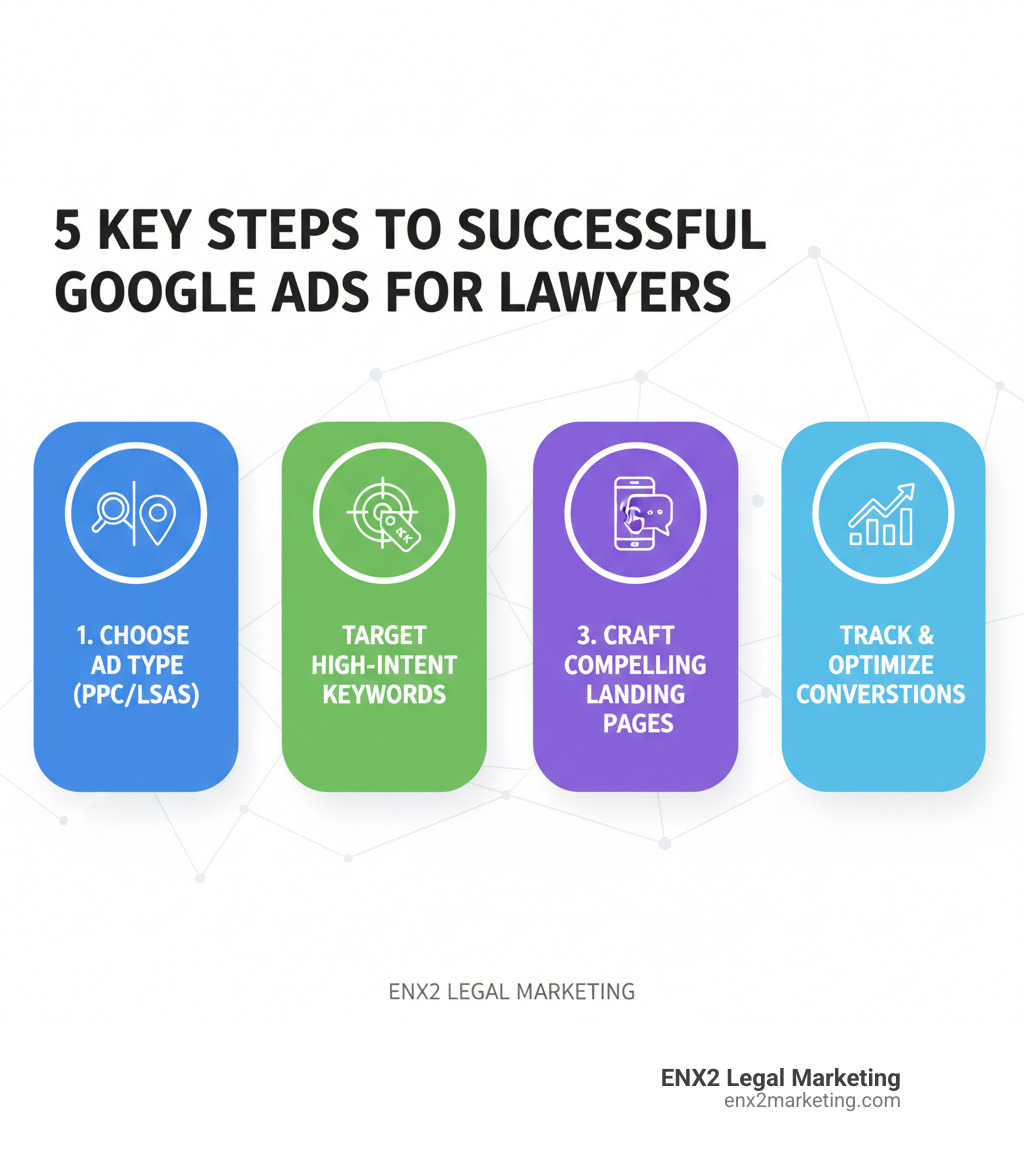
Keyword Research Tailored for Legal Services
Effective keyword research is foundational for successful Google Ads campaigns. Law firms must identify terms that potential clients use when searching for legal services. The following strategies can refine keyword selection:
- Long-tail keywords: Focus on specific phrases that reflect user intent, such as “family law attorney in [city]” rather than generic terms like “lawyer.”
- Local SEO keywords: Incorporate geo-specific keywords to attract clients in targeted areas, as 46% of all Google searches are for local information.
- Negative keywords: Regularly update your negative keyword list to exclude irrelevant searches, minimizing wasted ad spend.
Using Ad Extensions Effectively
Ad extensions enhance the visibility of ads and provide additional information to potential clients. Utilizing these extensions can improve click-through rates (CTR) significantly. Key ad extensions include:
- Call extensions: Enable potential clients to call directly from the ad, which is crucial for law firms where immediate consultation is often sought.
- Sitelink extensions: Direct users to specific pages on your website, such as practice areas or testimonials, increasing the likelihood of conversion.
- Location extensions: Show your firm’s address, making it easier for clients to find you, especially important for local searches.
Retargeting Strategies for Law Firms
Retargeting is a powerful tool for law firms to re-engage visitors who have previously interacted with their website. Implementing retargeting strategies can boost conversion rates by up to 400%. Consider the following approaches:
- Segmented audiences: Create tailored ads for different segments, such as visitors who viewed specific practice areas or completed a contact form.
- Dynamic ads: Use dynamic retargeting to show personalized ads based on the specific services users viewed, enhancing relevance and engagement.
- Frequency caps: Set frequency caps to avoid overexposure, which can lead to ad fatigue and negative brand perception.
Analyzing Competitor Campaigns for Insights
Understanding competitor strategies can provide valuable insights for optimizing your own Google Ads campaigns. Analyze competitors by:
- Identifying top competitors: Use tools like SEMrush or Ahrefs to uncover which firms are investing heavily in Google Ads and what keywords they target.
- Examining ad copy: Review competitors’ ad copy for messaging strategies and calls to action that resonate with potential clients.
- Monitoring landing pages: Analyze the design and content of competitors’ landing pages to identify effective elements that could enhance your own conversions.
Common misconceptions about Google Ads for law firms include the belief that higher bids always lead to better placement. In reality, quality scores, ad relevance, and landing page experience significantly influence ad positioning. Law firms should focus on creating highly relevant ads and optimizing landing page content to improve quality scores, which can lower costs and enhance ad visibility.
To implement these advanced strategies, law firms should:
- Conduct thorough keyword research using tools like Google Keyword Planner.
- Utilize all relevant ad extensions to provide comprehensive information.
- Set up segmented retargeting campaigns to effectively re-engage past visitors.
- Regularly analyze competitor campaigns to refine your approach based on industry best practices.
Common Mistakes Law Firms Make with Google Ads
This section identifies frequent errors law firms encounter with Google Ads and emphasizes their potential impact on campaign effectiveness. Addressing these mistakes is essential for optimizing advertising performance and maximizing return on investment.
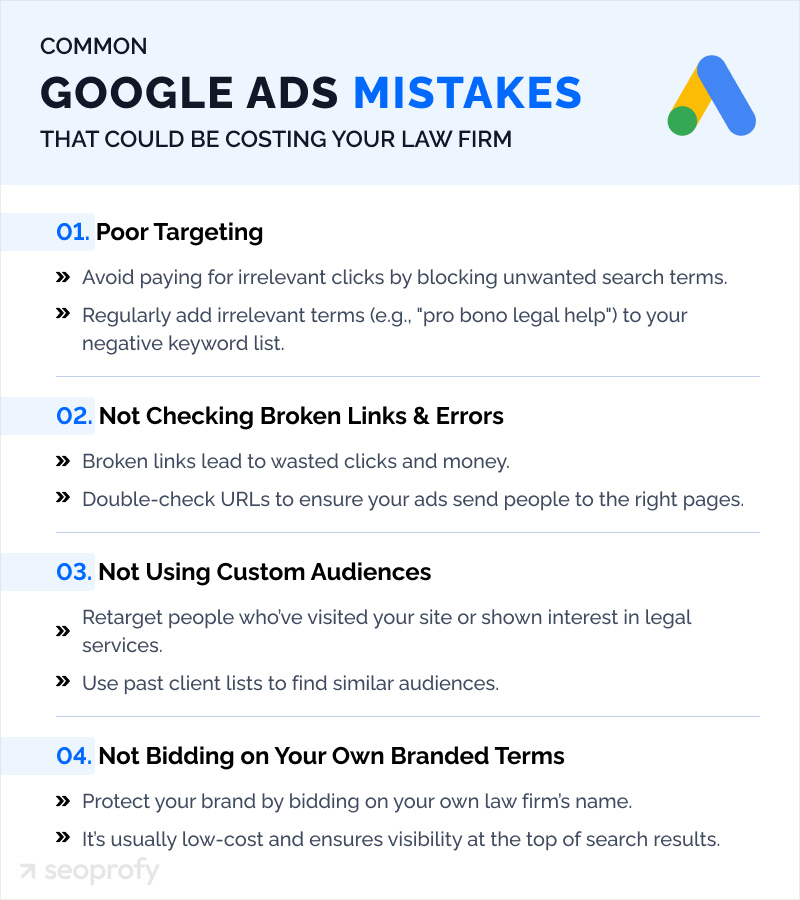
Neglecting Negative Keywords
One of the most significant oversights in Google Ads campaigns for law firms is the failure to utilize negative keywords. These keywords prevent ads from appearing in irrelevant searches, thereby saving budget and improving click-through rates. For instance, a personal injury law firm might want to exclude terms like “free” or “pro bono” to avoid attracting non-paying clients. According to a 2024 study, incorporating negative keywords can improve ad performance by up to 30%.
Overlooking Ad Copy Optimization
Ad copy plays a crucial role in attracting potential clients. Law firms often create generic or uninspiring ads that fail to communicate their unique value propositions. Effective ad copy should highlight specific services, include compelling calls to action, and utilize relevant keywords. A/B testing different headlines and descriptions can lead to significant improvements in click-through rates. For example, ads that mention specific legal services, such as “Estate Planning Attorney” rather than just “Lawyer,” can increase engagement by 25%.
Failing to Track Conversions Properly
Inadequate conversion tracking is a prevalent issue that hampers the ability of law firms to assess the effectiveness of their campaigns. Without clear data on conversions, such as form submissions or phone calls, optimizing campaigns becomes a challenge. Implementing tools like Google Analytics and setting up conversion goals are essential steps. A recent report indicated that firms that effectively track conversions see a 40% higher return on ad spend.
Ignoring Mobile Optimization
With over 60% of searches for legal services conducted on mobile devices, neglecting mobile optimization can lead to a significant loss of potential clients. Law firms must ensure that their ads, landing pages, and websites are mobile-friendly. This includes optimizing load times, simplifying navigation, and ensuring that contact forms are easily accessible. Ads that are optimized for mobile can yield conversion rates 50% higher than those that are not.
Expert Insight
Many law firms mistakenly believe that a larger budget alone will yield better results in Google Ads. While budget size does matter, the effectiveness of the ads relies heavily on targeting, ad quality, and ongoing optimization. Furthermore, focusing solely on high-traffic keywords can lead to increased competition and costs without guaranteeing client acquisition. A diverse keyword strategy that includes long-tail keywords can often yield better results at a lower cost.
Practical Application
- Conduct a thorough audit of existing negative keywords and incorporate new ones based on search query reports.
- Revise ad copy to focus on specific services and unique selling points, testing variations for effectiveness.
- Implement robust conversion tracking using tools like Google Analytics to monitor and analyze performance.
- Ensure all ads and landing pages are optimized for mobile viewing to capture the growing number of mobile users.
Local SEO and Google Ads: A Perfect Pair for Law Firms
This section examines how local SEO and Google Ads can work together to maximize visibility for law firms, particularly through geographical targeting strategies.
Importance of Local Keywords
Utilizing local keywords is essential for law firms aiming to attract clients in specific geographic areas. These keywords often include the location combined with legal services, such as “personal injury lawyer in Los Angeles” or “family attorney in Brooklyn.” In 2024, over 75% of consumers reported using local searches to find services in their area, highlighting the necessity of targeting local terms effectively.
Setting Up Location Targeting in Google Ads
Location targeting in Google Ads allows law firms to focus their advertising efforts on specific regions. This can be set up through the following steps:
- Log into your Google Ads account.
- Select the campaign you wish to modify.
- Navigate to the “Settings” section and find “Locations.”
- Choose your target area by entering specific cities, regions, or a radius around your practice.
Effective location targeting ensures that ads are shown to potential clients actively searching for legal services in their vicinity, increasing conversion rates.
Leveraging Google My Business for Visibility
Google My Business (GMB) plays a critical role in enhancing local visibility. By claiming and optimizing a GMB listing, law firms can appear in local search results and Google Maps. Key actions include:
- Completing all fields in the GMB profile, including practice areas, contact information, and operating hours.
- Encouraging satisfied clients to leave positive reviews, which can boost local rankings.
- Regularly posting updates and relevant content to engage with potential clients.
Data shows that businesses with complete GMB listings receive 70% more clicks than those without.
Combining Local SEO Strategies with Paid Ads
Integrating local SEO strategies with Google Ads enhances overall effectiveness. For instance, using insights from SEO keyword research can inform ad copy, ensuring consistency across organic and paid channels. Additionally, retargeting ads can be employed to engage users who previously visited the firm’s website, reinforcing brand presence.
According to recent studies, law firms that combine local SEO with Google Ads can see a 30% increase in lead generation, indicating the power of a cohesive digital marketing strategy.
Nuance / Expert Layer
Many law firms mistakenly prioritize either local SEO or Google Ads in isolation. However, the most effective approach integrates both strategies. For instance, a firm may rank high organically for “divorce lawyer in Miami,” but without paid ads targeting the same keyword, it risks losing visibility to competitors investing in that space. Additionally, understanding the local competition and adjusting budgets and bids in Google Ads can lead to more efficient spending and better ROI.
Practical Application
To leverage the synergy between local SEO and Google Ads, law firms should:
- Conduct thorough local keyword research and implement these keywords in both SEO and ad campaigns.
- Set up precise location targeting in Google Ads to focus on areas with high demand for legal services.
- Claim and optimize their Google My Business listing to enhance local search visibility.
- Monitor performance metrics for both channels to adjust strategies and budgets accordingly.
By following these steps, law firms can optimize their online presence and attract more local clients effectively.
Measuring ROI: How to Evaluate Your Google Ads Performance
This section provides a framework for law firms to assess the effectiveness of their Google Ads campaigns. By analyzing key metrics and performance data, firms can optimize their advertising strategies to maximize return on investment.

Key Metrics to Track for Legal Ads
To effectively measure the success of Google Ads, law firms should monitor several critical metrics:
- Click-Through Rate (CTR): This metric indicates the percentage of users who click on an ad after seeing it. A higher CTR suggests that the ad is relevant and engaging.
- Conversion Rate: This represents the percentage of users who take a desired action, such as filling out a contact form or calling the firm. A robust conversion rate indicates effective landing page design and ad targeting.
- Quality Score: Google assigns a Quality Score based on the relevance of the ad, expected CTR, and landing page experience. A higher Quality Score can lead to lower costs and better ad placements.
Calculating Customer Acquisition Cost
Customer Acquisition Cost (CAC) is a vital metric that law firms must calculate to assess their advertising effectiveness. The formula for CAC is:
CAC = Total Ad Spend / Number of New Clients Acquired
For example, if a law firm spends $5,000 on Google Ads and acquires 10 new clients, the CAC would be $500. Understanding this cost helps firms evaluate whether their advertising spend is sustainable and profitable.
Using Google Analytics for Deeper Insights
Google Analytics provides comprehensive data that can enhance the understanding of Google Ads performance. By linking Google Ads with Google Analytics, law firms can gain insights into user behavior on their website. Key areas to explore include:
- Source/Medium Report: This shows how users arrive at the website, allowing firms to assess the effectiveness of different campaigns.
- Behavior Flow: This visual representation depicts the path users take through the site, helping identify potential drop-off points.
- Goal Tracking: Set up specific goals in Google Analytics to measure actions that align with business objectives, such as form submissions or phone calls.
Adjusting Strategies Based on Performance Data
Analyzing performance data allows law firms to refine their Google Ads strategies. Common adjustments include:
- Ad Copy Optimization: A/B testing different ad copies can reveal which messages resonate best with the target audience.
- Keyword Management: Regularly reviewing keyword performance enables firms to eliminate underperforming keywords and focus on high-converting terms.
- Budget Reallocation: Shifting budget towards the best-performing campaigns can maximize overall ROI.
Nuanced Considerations
Many law firms underestimate the importance of long-term tracking. While initial metrics like CTR and CAC provide immediate insights, trends over time reveal the sustainability of campaigns. Additionally, a common misconception is that a high CTR guarantees conversion success. In reality, a low conversion rate could indicate issues with the landing page or the quality of traffic generated by the ads. Focusing solely on immediate results can lead to misguided adjustments that hinder long-term growth.
Practical Application
To leverage this information, law firms should implement a structured evaluation process for their Google Ads campaigns. Establish a routine for tracking key metrics, calculating CAC, and utilizing Google Analytics insights. Regularly review performance data to inform strategic adjustments, ensuring that advertising efforts align with overall business goals. By adopting a data-driven approach, law firms can enhance their Google Ads effectiveness, ultimately increasing client acquisition and maximizing ROI.
Evaluating the Best Google Ads For Law Firms
In the competitive landscape of legal marketing, choosing the right advertising platform is crucial for law firms aiming to maximize their reach and efficiency. With the legal advertising market projected to reach $10 billion by 2026, law firms must evaluate options based on specific criteria such as cost-per-click, target audience, and unique features. This comparison will help legal practitioners make informed decisions that align with their marketing goals.
| Provider / Option | Best For | Pricing | Key Feature |
|---|---|---|---|
| Google Ads | General law firm advertising | $1 to $2 per click | Extensive reach and targeting options |
| Bing Ads | Cost-effective alternative | $0.50 to $1.50 per click | Lower competition in legal niches |
| Facebook Ads | Social engagement and branding | $0.50 to $3 per click | Visual appeal and audience targeting |
| LinkedIn Ads | B2B legal services | $2 to $7 per click | Professional audience targeting |
| LawLytics | Integrated legal marketing | $300 to $500 monthly | Law firm-specific tools and support |
| AdWords for Lawyers | Full-service law firm marketing | $500 to $2000 monthly | Tailored strategies for legal practices |
Criteria for Evaluating Program Quality
- Cost-Effectiveness: Analyze the cost-per-click associated with each platform to determine which option fits your budget while maximizing potential traffic.
- Target Audience: Consider each platform’s ability to target specific demographics relevant to your legal services, ensuring your ads reach the right clients.
- Unique Features: Evaluate the key features offered by each provider, such as targeting options or marketing tools tailored for law firms, to enhance your advertising strategy.
- Support and Resources: Look for providers that offer dedicated support and resources, especially those specifically designed for legal marketing, to assist in optimizing campaigns.
How to Assess the Reputation and Reliability of Providers
- Research Customer Reviews: Look for testimonials and reviews from other law firms to gauge satisfaction and effectiveness.
- Check Industry Credentials: Verify if the provider has experience and recognition within the legal marketing space.
- Request Case Studies: Ask for examples of successful campaigns they have managed for similar firms, to understand their capabilities.
- Evaluate Customer Support: Contact their support team to assess responsiveness and the quality of assistance they provide.
- Analyze Transparency: Ensure the provider is clear about pricing, services, and contract terms to avoid hidden fees or unexpected issues.
Which Google Ads For Law Firms Is Right for You?
The optimal Google Ads strategy for law firms hinges on specific business needs, budget constraints, and overall goals. This guide provides tailored recommendations for various audience segments within the legal industry, ensuring that each firm can effectively attract and engage potential clients.
Solo practitioners
Solo practitioners should concentrate on Google Ads with localized targeting to capture clients in their immediate geographic area. Utilizing location-based keywords and setting a budget of around $500 to $1,500 per month can yield significant results in attracting local clientele.
Small law firms
Small law firms can benefit from a hybrid approach, employing both Google Ads and Facebook Ads to enhance visibility and engagement. Allocating a budget of $1,500 to $3,000 monthly across these platforms can help reach a wider audience while driving traffic to the firm’s website and social media pages.
Large law firms
Large law firms should invest in comprehensive Google Ads campaigns, dedicating specific budgets for various practice areas such as family law, corporate law, or personal injury. A budget of $5,000 to $10,000 monthly is advisable to effectively manage multiple campaigns and maximize visibility across competitive keywords.
Law firms targeting businesses
For law firms focusing on B2B engagements, leveraging LinkedIn Ads is essential for networking and connecting with potential business clients. A budget of around $1,000 to $2,500 per month can facilitate targeted campaigns directed at specific industries or job titles, enhancing lead generation.
Legal service providers
Legal service providers should consider using Bing Ads, which often offer lower-cost clicks in less competitive niches compared to Google Ads. A budget of $300 to $800 per month can effectively drive traffic while maximizing return on investment in specialized areas.
| If You Are… | Best Approach |
|---|---|
| Solo practitioners | Localized Google Ads, $500-$1,500/month |
| Small law firms | Google & Facebook Ads, $1,500-$3,000/month |
| Large law firms | Comprehensive Google Ads, $5,000-$10,000/month |
| Law firms targeting businesses | LinkedIn Ads, $1,000-$2,500/month |
| Legal service providers | Bing Ads, $300-$800/month |
Local Insights for Google Ads Targeting Law Firms
Understanding local market dynamics is crucial for law firms leveraging Google Ads. Approximately 46% of all Google searches are local, emphasizing the importance of targeting specific geographic areas. Tailoring ad campaigns to local audiences can significantly enhance client acquisition, with local businesses seeing a 29% increase in conversion rates when utilizing location-based advertising strategies.
Geographic Market Differences
In highly competitive markets like New York City or Los Angeles, law firms must invest more in Google Ads to stand out, often requiring higher bids due to increased competition. Conversely, in smaller towns or less saturated regions, firms may find more cost-effective opportunities with lower bids and less competition for key terms. Understanding local demographics and legal service demand is essential for optimizing ad spend.
Local Business Applications
Local law firms can leverage Google Ads in several impactful ways:
- Target specific practice areas (e.g., personal injury, family law) relevant to local community needs.
- Utilize geo-targeting to reach potential clients within specific ZIP codes or neighborhoods.
- Incorporate local keywords in ad copy to enhance relevance, such as “divorce lawyer in [City].”
- Run promotions or events targeting local audiences, such as free legal consultations, to increase engagement.
Local Search and Visibility Impact
Google Ads plays a vital role in improving local search visibility. Law firms should ensure their Google Business Profile is optimized, including accurate contact information, hours, and client reviews. To enhance local search performance, consider the following steps:
- Regularly update Google Business Profile with posts about services and client testimonials.
- Utilize location-based ad extensions to provide direct links to your law firm’s contact information.
- Encourage satisfied clients to leave reviews, boosting both Google Ads performance and organic search visibility.
- Monitor local keywords and trends to adjust ad campaigns based on community needs.
Pricing and Cost in Local Markets
Costs for Google Ads can vary significantly by geographic market. In cities like San Francisco, the average cost-per-click (CPC) for legal services can range from $6 to $12, while in smaller markets, it may drop to between $2 and $5. Local firms often need to budget around $1,000 to $3,000 monthly for effective campaigns, whereas national firms may allocate significantly more, sometimes upwards of $10,000, depending on their reach and competition.
Local Implementation Checklist:
- Identify and target specific local keywords relevant to your practice.
- Optimize your Google Business Profile for accuracy and engagement.
- Set a competitive budget based on local market analysis.
- Use geo-targeting to focus ads on specific neighborhoods or ZIP codes.
- Encourage and respond to client reviews to boost local visibility.
- Regularly analyze ad performance and adjust strategies accordingly.
- Engage with the community through local events or sponsorships to enhance brand awareness.
For law firms looking to generate local leads through Google Ads or Local SEO, GMB Ranger LLC offers hands-on campaign management. Specialist Md Tangeer Mehedi personally handles campaign setup and ongoing optimization — with no payment required until the first lead comes in.
Frequently Asked Questions
What are Google Ads for law firms?
Google Ads for law firms are paid online advertisements that appear on Google search results and partner sites. These ads help law firms reach potential clients actively searching for legal services.
How can law firms effectively use Google Ads?
Law firms can effectively use Google Ads by targeting specific keywords relevant to their practice areas and optimizing ad copy for conversions. Regularly analyzing performance metrics and adjusting strategies based on data is also essential.
What is the average cost of Google Ads for lawyers?
The average cost of Google Ads for lawyers varies, typically ranging from $2 to $10 per click, depending on competition and location. Budgets can be adjusted based on campaign goals and performance.
How long does it take to see results from Google Ads?
Results from Google Ads can often be seen within a few days to weeks, depending on the campaign setup and budget. However, significant insights and optimizations usually require several weeks of data collection.
What are the best practices for Google Ads in legal marketing?
Best practices for Google Ads in legal marketing include using targeted keywords, creating compelling ad copy, and implementing geo-targeting. Additionally, regularly monitoring and optimizing campaigns is crucial for success.
How do Google Ads compare to other advertising methods for law firms?
Google Ads generally provide immediate visibility and targeted reach compared to traditional advertising methods. They allow law firms to connect with potential clients actively searching for legal services, often resulting in higher conversion rates.
What mistakes should law firms avoid in Google Ads?
Common mistakes law firms should avoid in Google Ads include neglecting keyword research, setting unrealistic budgets, and failing to optimize landing pages. Additionally, not tracking performance metrics can lead to wasted ad spend and missed opportunities.
Final Thoughts on Google Ads for Law Firms
Success in Google Ads for law firms hinges on a strategic approach that combines compelling ad copy, rigorous keyword research, and effective budget management. Understanding the nuances of local SEO and avoiding common pitfalls can significantly enhance campaign performance and ROI.
Law firms should conduct a comprehensive audit of their current Google Ads campaigns, identifying areas for optimization, such as ad targeting and conversion tracking, to ensure they are maximizing their investment and driving qualified leads.
Ready to take your law firm’s marketing to the next level? Consider partnering with a google ads management agency for expert guidance and support.
Mastering Google Ads is not just a tactical choice; it is essential for law firms aiming to thrive in an increasingly competitive digital landscape.
Leave a Reply