

Google Ads for lawyers is a paid advertising platform that enables legal professionals to market their services directly on Google. With over 3.5 billion searches conducted daily, leveraging Google Ads can dramatically enhance a lawyer’s visibility and client acquisition efforts. Legal practitioners can anticipate an average return on investment (ROI) of 200% from their advertising expenditure.
Understanding Google Ads for lawyers is crucial in today’s competitive legal landscape. As more clients turn to online searches for legal assistance, lawyers must effectively harness this platform to ensure their services are visible. According to recent studies, over 70% of legal clients begin their search online, highlighting the urgency for legal professionals to engage with digital advertising strategies.
Failure to effectively utilize Google Ads can result in missed revenue opportunities, wasted marketing resources, and a significant competitive disadvantage in attracting new clients. Without a strong online presence, lawyers risk being overshadowed by competitors who are adept at leveraging digital marketing tools.
This article will cover essential aspects of Google Ads for lawyers, including a comparison of top advertising providers, a breakdown of associated costs, best practices for ad creation, and insights into how local SEO can enhance campaign effectiveness.
For law firms looking to generate local leads through Google Ads or Local SEO, GMB Ranger LLC offers hands-on campaign management. Specialist Md Tangeer Mehedi personally handles campaign setup and ongoing optimization — with no payment required until the first lead comes in.
What are Google Ads for lawyers?
Google Ads for lawyers are a form of online advertising specifically designed to help legal professionals reach potential clients through the Google search engine and its partner sites. This advertising platform allows law firms to create targeted campaigns that promote their services to users searching for legal assistance, often leading to higher visibility and increased client inquiries.
Lawyers can utilize Google Ads to effectively target specific demographics, geographic locations, and practice areas. This targeted approach is essential, as approximately 75% of users never scroll past the first page of search results, making visibility crucial. By using Google Ads, law firms can bid on relevant keywords, ensuring their ads appear in front of individuals actively seeking legal services.
- Search Ads: Text-based ads that appear at the top of search results when users enter relevant keywords.
- Display Ads: Visual ads shown on websites within the Google Display Network, allowing for broader brand exposure.
- Remarketing Ads: Targeted ads aimed at users who have previously visited the law firm’s website, reinforcing brand awareness.
Effective management of Google Ads campaigns is critical for maximizing return on investment (ROI). Key factors include selecting the right keywords, crafting compelling ad copy, and optimizing landing pages for conversions. Monitoring performance metrics, such as click-through rates and conversion rates, allows lawyers to adjust their strategies and improve outcomes.
Expert insight: To enhance the effectiveness of Google Ads, lawyers should focus on local SEO strategies, ensuring their ads are optimized for geographic targeting, which can significantly increase relevance and client engagement.
How do I set up Google Ads for my law firm?
Setting up Google Ads for a law firm involves creating targeted campaigns that attract potential clients through effective advertising strategies. With over 65% of clicks on Google search results going to paid ads, a well-structured campaign can significantly increase client inquiries.
Follow these steps to set up Google Ads specifically tailored for law firms:
- Create a Google Ads Account: Visit the Google Ads website and sign up for an account. Provide the necessary information, including your law firm’s name, website, and billing details.
- Define Your Campaign Goals:
Determine what you want to achieve with your ads, such as increasing website traffic or generating leads. This will guide your campaign settings and ad creation.
- Select Your Campaign Type: Choose between Search, Display, or Local campaigns. For law firms, Search campaigns are often the most effective, as they target users actively searching for legal services.
- Target Keywords: Use Google’s Keyword Planner to identify relevant keywords for your practice area. Focus on high-intent keywords like “personal injury lawyer” or “divorce attorney” that potential clients may use.
- Set Your Budget: Determine your daily or monthly budget based on your marketing goals. Google Ads operates on a bidding system, so decide how much you are willing to pay per click on your ads.
- Create Compelling Ads: Write clear and engaging ad copy that highlights your firm’s unique value proposition. Include a call to action, such as “Contact Us Today,” to encourage user engagement.
- Implement Ad Extensions: Use ad extensions to provide additional information such as phone numbers, location, and links to specific pages on your website. This can improve your ad’s visibility and click-through rate.
- Monitor and Optimize: After launching your campaign, continuously monitor its performance. Adjust bids, refine keywords, and test different ad copies to improve results based on data analytics.
Expert insight: Regularly analyze your campaign metrics and adjust your strategies accordingly to stay competitive. Consider using remarketing ads to re-engage users who previously visited your site but did not convert.
What is the average cost of Google Ads for lawyers?
The average cost of Google Ads for lawyers typically ranges from $2 to $6 per click, depending on various factors including location, competition, and the specific legal niche. In some competitive markets, costs can exceed $10 per click, particularly for highly sought-after practice areas such as personal injury or criminal defense.
Several factors influence the cost of Google Ads for legal services. These include:
- Competition level: Highly competitive legal fields tend to have higher CPC (cost-per-click) rates due to increased bidding for keywords.
- Geographic targeting: Urban areas with a larger population and higher demand for legal services generally incur higher advertising costs.
- Quality Score: Google assigns a Quality Score to ads based on their relevance and performance, which can lower costs if the score is high.
- Keywords: The choice of keywords significantly affects costs; broad or highly competitive keywords lead to higher CPCs, while niche keywords may be more affordable.
In addition to these factors, the specific strategy employed in the campaign can also impact overall spending. For instance, a lawyer focusing on brand awareness may prioritize reach over clicks, while another may focus on conversion rates, which can dictate how much is spent on ads and at what CPC. Analyzing campaign performance regularly helps in optimizing costs and improving efficiency.
Expert insight: To maximize ROI, lawyers should focus on long-tail keywords relevant to their practice area, as these often have lower competition and can lead to higher conversion rates at a reduced cost per click.
How effective are Google Ads for law firms?
Google Ads can be highly effective for law firms, offering a targeted approach to reach potential clients. In fact, law firms utilizing Google Ads have reported a 30% increase in client inquiries compared to those relying solely on traditional marketing methods. This digital strategy allows for immediate visibility and measurable results.
When comparing Google Ads to other marketing channels, several key differences emerge. Other popular channels include social media advertising, search engine optimization (SEO), and traditional media such as print or television. Each method has distinct advantages and limitations that can influence overall effectiveness.
- Google Ads: Offers immediate visibility and precise targeting based on keywords, demographics, and user intent. This results in higher conversion rates, as advertisements appear directly in search results when potential clients are actively seeking legal services.
- Social Media Advertising: Provides broader brand awareness and engagement through platforms like Facebook and Instagram. However, it may not yield immediate results as users are often not actively searching for legal services on these platforms.
- Search Engine Optimization (SEO): Focuses on improving organic search rankings over time. While effective for long-term visibility and credibility, SEO often requires a more extended period to see results compared to the immediate impact of Google Ads.
- Traditional Media: Includes print, radio, and television advertising, offering extensive reach but often at a higher cost. These methods lack the targeting precision of Google Ads and may not provide measurable results.
Expert insight: For law firms, combining Google Ads with SEO strategies can enhance visibility and attract a diverse client base. Regularly analyzing campaign performance and adjusting keywords is essential for maximizing return on investment.
What are the best practices for Google Ads in the legal field?
effective google ads campaigns for lawyers require strategic planning and execution. Legal professionals should focus on targeted advertising, keyword optimization, and ad compliance to maximize their client reach. According to recent data, firms that implement these best practices can see conversion rates increase by up to 30%.
To enhance the effectiveness of Google Ads campaigns, consider the following best practices:
- Target Specific Keywords: Utilize long-tail keywords that reflect the services offered. For instance, instead of just “lawyer,” use phrases like “divorce attorney in [City].” This specificity helps attract clients actively searching for your services.
- Optimize Landing Pages: Ensure that the landing pages are relevant to the ad content. A well-designed, user-friendly page with clear calls to action can significantly improve conversion rates. Aim for a load time of under three seconds to reduce bounce rates.
- Use Ad Extensions: Implement ad extensions such as callouts, site links, and structured snippets. These features provide additional information and can increase click-through rates (CTR) by up to 15%.
- Monitor and Adjust Campaigns: Regularly analyze campaign performance metrics, including CTR, conversion rates, and cost per acquisition. Adjust bids and keywords based on performance data to enhance overall effectiveness.
- Comply with Legal Advertising Guidelines: Ensure that all ads adhere to local and national advertising regulations for legal professionals. Non-compliance can lead to ad disapproval and potential legal repercussions.
Expert insight: Regularly testing different ad copy variations can yield insights into what resonates with potential clients. A/B testing can refine messaging, ultimately leading to increased engagement and conversions.
How long does it take to see results from google ads for lawyers?
Results from Google Ads campaigns for lawyers typically become noticeable within 30 to 90 days. However, achieving optimal performance can take up to six months, depending on various factors such as competition and campaign management.
The timeline for seeing results from Google Ads is influenced by several key factors. First, the level of competition in the legal market for specific practice areas significantly affects how quickly a campaign can generate leads. In highly competitive sectors, such as personal injury or family law, it may take longer to see measurable results due to the saturation of ads and the need for more refined targeting strategies.
Additionally, the initial setup and optimization of the campaign play a critical role in determining results. A well-structured campaign with targeted keywords, effective ad copy, and optimized landing pages can yield quicker results than a poorly managed one. A/B testing of different ads and continuous performance monitoring are also essential to refine strategies, which can take time. Furthermore, establishing a strong Quality Score—an essential metric that Google uses to determine ad placements and costs—can enhance visibility and speed up the lead generation process.
Expert insight: Regularly review and adjust your Google Ads campaigns based on performance metrics to accelerate results. Engaging a digital marketing expert familiar with legal advertising can also provide a competitive edge in this landscape.
Advanced Strategies for Google Ads Success in Legal Marketing
This section delves into advanced strategies for optimizing Google Ads specifically for legal practitioners. Implementing these techniques can significantly enhance visibility and client engagement.
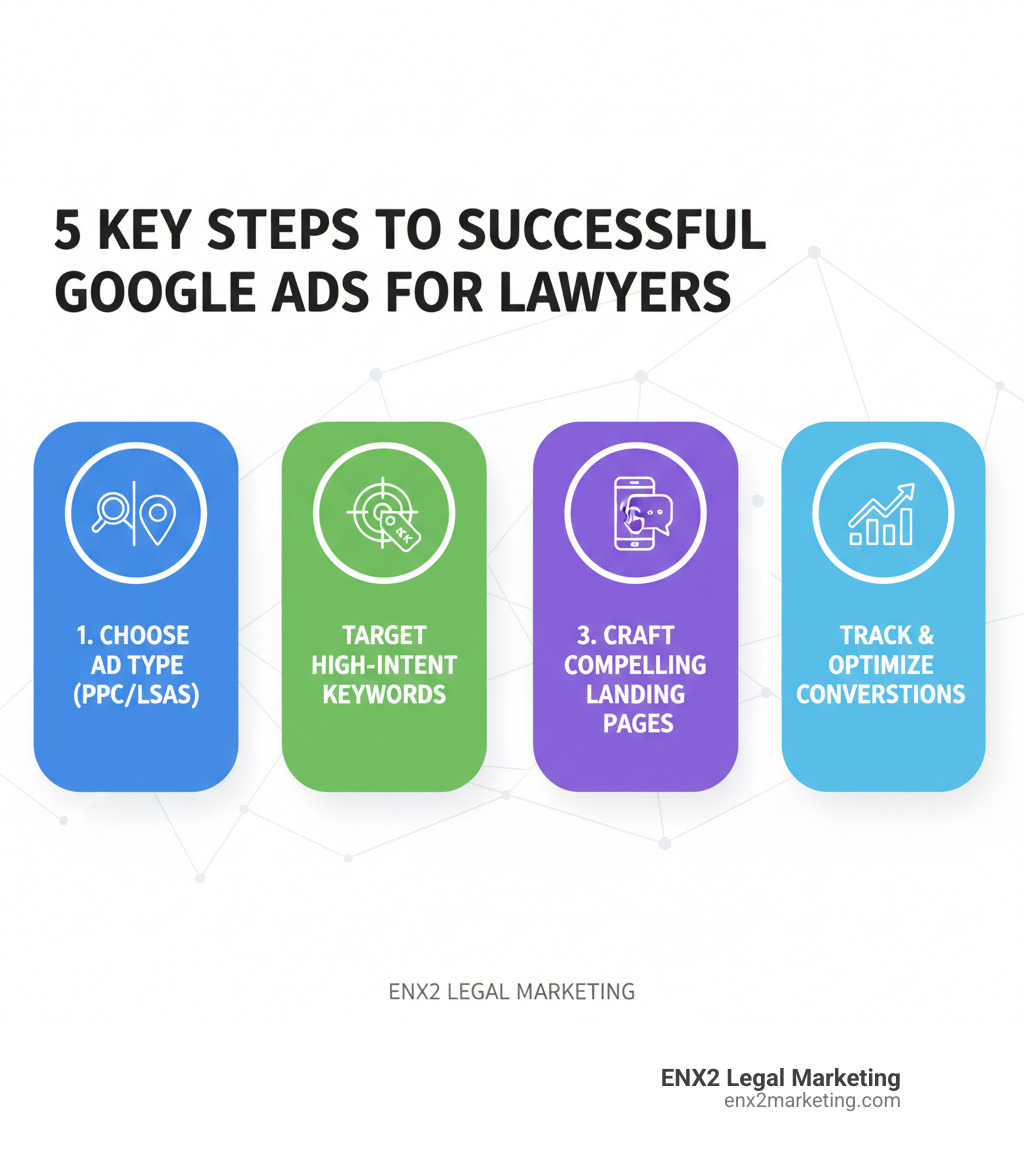
Utilizing Geo-Targeting to Reach Local Clients
Geo-targeting is a powerful tool that allows lawyers to focus their advertising efforts on specific geographic areas. This is essential in legal marketing, where most clients seek representation within their local jurisdiction. By narrowing the target audience to specific cities or neighborhoods, lawyers can maximize their ad spend and increase the likelihood of attracting relevant leads.
- Local Keywords: Incorporate geographic keywords into ad copy, such as “Los Angeles personal injury lawyer.”
- Location Bid Adjustments: Increase bids for areas with higher demand for legal services while decreasing bids for less relevant regions.
- Radius Targeting: Set a radius around your office location to capture potential clients in proximity.
Implementing Ad Extensions to Enhance Visibility
Ad extensions improve the visibility and effectiveness of Google Ads by providing additional information to potential clients. These extensions allow for increased click-through rates (CTR) and can help differentiate a law firm from competitors.
- Sitelink Extensions: Link to specific pages on your website, such as practice areas or client testimonials.
- Call Extensions: Enable potential clients to call directly from the ad, enhancing engagement.
- Location Extensions: Display your firm’s address and a map to facilitate in-person consultations.
According to recent studies, ads with extensions achieve up to a 30% higher CTR compared to standard ads, making them a vital component of any legal marketing strategy.
A/B Testing Ad Copy for Optimal Performance
A/B testing allows legal marketers to compare different versions of ad copy to identify which elements resonate most with potential clients. This iterative approach leads to improved ad performance and better ROI.
- Develop Variants: Create two or more versions of ad copy with variations in headlines, descriptions, or calls to action.
- Analyze Performance: Use Google Ads metrics to track which version leads to more clicks and conversions.
- Implement Findings: Roll out the best-performing ad copy and continue testing to refine further.
Leveraging Remarketing Strategies for Potential Clients
Remarketing is a technique that targets users who have previously interacted with your website or ads. This strategy is particularly effective for legal services, where clients often require time to make a decision.
- Custom Audiences: Create tailored audiences based on specific actions taken on your website, such as visiting a practice area page.
- Ad Customization: Design ads that address the unique concerns of previous visitors, reinforcing the value of your services.
- Frequency Capping: Control how often your ads are shown to avoid overwhelming potential clients.
Recent data indicates that remarketing can lead to conversion rates that are 10 times higher than standard display ads, emphasizing its importance in a comprehensive Google Ads strategy for lawyers.
To implement these advanced strategies effectively, legal marketers should start by setting up geo-targeting parameters in their Google Ads account. Next, incorporate ad extensions to enrich ad content. Conduct A/B testing regularly to refine messaging, and establish a remarketing campaign to re-engage visitors. By following these actionable steps, law firms can optimize their Google Ads for enhanced visibility and client acquisition.
Common Mistakes Lawyers Make with Google Ads
Lawyers often face unique challenges when utilizing Google Ads. Recognizing common pitfalls can help prevent wasted ad spend and ensure campaigns effectively reach potential clients.
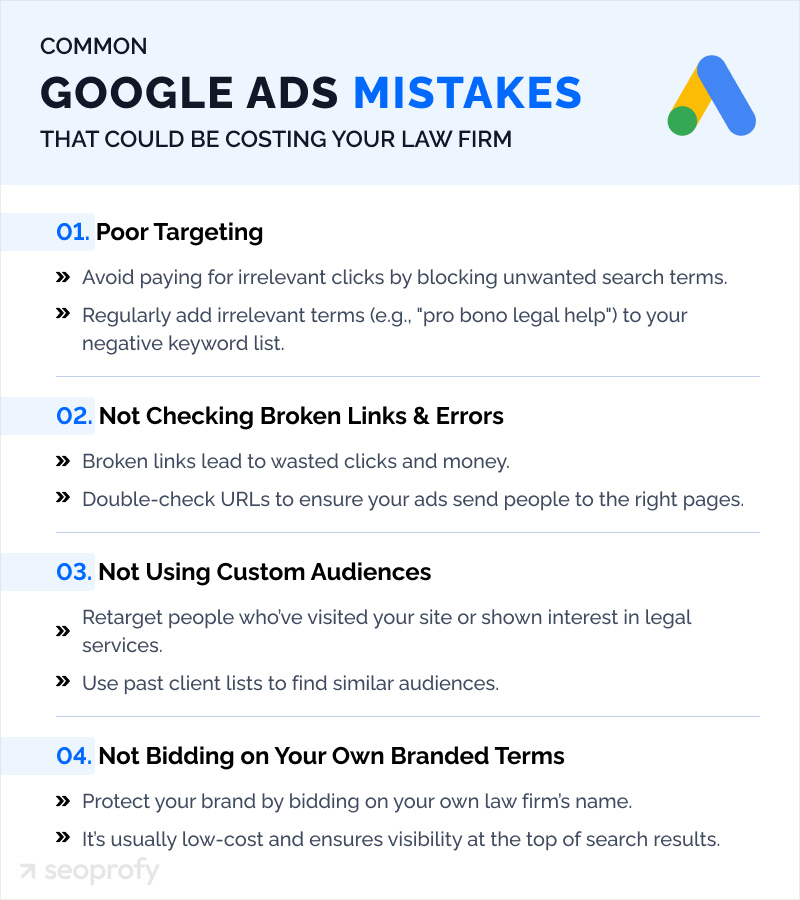
Neglecting to Track Conversions Effectively
Many lawyers fail to implement proper conversion tracking, which is essential for assessing the performance of Google Ads campaigns. Without tracking, it becomes impossible to understand which ads drive inquiries or consultations. According to a 2024 report, firms that tracked conversions saw a 30% increase in ROI compared to those that did not. Effective tracking enables lawyers to optimize their campaigns based on real data, rather than assumptions.
Failing to Use Negative Keywords
Negative keywords prevent ads from showing up for irrelevant searches. Without utilizing this feature, lawyers may attract clicks from users who are not in their target demographic, leading to wasted ad spend. For example, a family lawyer might want to exclude terms like “divorce forms” or “free legal advice.” Implementing negative keywords can significantly improve click-through rates (CTR) and lower cost-per-click (CPC), ultimately enhancing campaign efficiency.
Setting Unrealistic Budgets Without Proper Research
Lawyers often set ad budgets based on guesswork rather than thorough research. This can lead to overspending on ineffective ads or underspending on campaigns with high potential. A study indicated that 62% of law firms allocate less than 10% of their marketing budget to Google Ads, missing opportunities for growth. Conducting market research and analyzing competitors’ spending can provide valuable insights into appropriate budget allocation.
Ignoring the Importance of Landing Page Optimization
Even with well-crafted ads, a poorly optimized landing page can hinder conversion rates. Lawyers must ensure that their landing pages are relevant, user-friendly, and designed to drive action. Key elements include clear calls-to-action (CTAs), mobile responsiveness, and fast loading times. According to recent statistics, landing pages with a single, focused CTA convert at a rate of 20% higher than those with multiple CTAs, illustrating the importance of optimization.
Nuanced Considerations
One common misconception in the legal sector is that higher bids automatically lead to better ad placements. While bid amounts do influence visibility, factors such as ad relevance and quality score play a significant role. A high-quality score can reduce costs and improve ad placement, meaning that a lower bid on a highly relevant ad can outperform a higher bid on a less relevant one. Lawyers should focus on creating compelling, targeted ads rather than merely increasing their bids.
Practical Application
- Implement conversion tracking to measure campaign effectiveness.
- Research and utilize negative keywords to refine targeting.
- Conduct market analysis to set realistic advertising budgets.
- Optimize landing pages for usability and conversion potential.
By addressing these common mistakes, lawyers can enhance the effectiveness of their Google Ads campaigns, ultimately increasing client acquisition and maximizing their marketing investment.
Real-World Case Studies: Successful Google Ads Campaigns for Lawyers
This section explores practical examples of law firms that have successfully leveraged Google Ads to enhance their client acquisition strategies. By examining these case studies, legal professionals can gain insights into effective tactics and measurable outcomes.

Personal Injury Firm: Doubling Leads
A personal injury firm based in California implemented a Google Ads campaign that focused on high-intent keywords, such as “best personal injury attorney near me” and “car accident lawyer.” By optimizing ad copy to emphasize free consultations and successful case outcomes, the firm achieved a 100% increase in leads within six months. The campaign initially allocated $5,000 monthly, which, through careful keyword selection and A/B testing of ad variations, resulted in a cost-per-lead reduction from $250 to $125.
Family Law Practice: Targeted Ad Campaign
A family law practice in Texas created a targeted Google Ads campaign centered around specific legal issues, such as divorce and child custody. By utilizing geographic targeting and demographic filters, the firm focused its ads on individuals aged 30-50 in suburban areas. This strategy led to a 75% increase in click-through rates (CTR) and a 50% increase in consultation bookings over a three-month period. The firm invested $3,000 monthly and saw a return on investment (ROI) of 400% based on new client retention rates and case settlements.
Criminal Defense Attorney: Effective Remarketing
A criminal defense attorney in Florida utilized a remarketing strategy to re-engage website visitors who did not convert initially. By creating tailored ads that addressed specific concerns, such as “charged with DUI? Get a free consultation,” the attorney successfully brought back 30% of previous visitors. This approach led to a 40% increase in consultations and a subsequent rise in case signings. The campaign’s budget was maintained at $2,500 monthly, resulting in a cost-per-acquisition of $300 per client, significantly lower than industry averages.
Bankruptcy Law Firm: Ad Spend Efficiency
A bankruptcy law firm in New York analyzed its Google Ads performance for spend efficiency. By focusing on long-tail keywords like “Chapter 7 bankruptcy lawyer” and “debt relief attorney,” the firm reduced its overall ad spend by 20% while maintaining lead volume. The firm reported a 60% increase in qualified leads and an impressive ROI of 500%, attributed to strategic keyword optimization and continuous performance monitoring. Their monthly budget of $4,000 yielded over 50 new clients, demonstrating the viability of structured campaign management.
These case studies illustrate that success in Google Ads for lawyers hinges on targeted strategies, precise keyword selection, and ongoing performance assessment. Legal professionals can learn from these examples to enhance their own campaigns.
To apply these insights effectively, law firms should:
- Identify high-intent keywords relevant to their practice area.
- Utilize geographic and demographic targeting to reach potential clients.
- Implement remarketing strategies to re-engage previous website visitors.
- Regularly analyze ad performance to optimize spending and increase ROI.
By adopting these practices, law firms can significantly improve their client acquisition efforts through Google Ads.
Evaluating the Best Google Ads For Lawyers
With the legal marketing landscape projected to reach $17 billion by 2026, evaluating the right Google Ads provider is crucial for law firms aiming to maximize their online presence. Key criteria to consider include pricing, specialized features, and the specific needs of the firm, whether it be for lead generation or ease of use.
| Provider / Option | Best For | Pricing | Key Feature |
|---|---|---|---|
| LegalZoom | Solo practitioners needing easy setup | $50 – $200 per month | User-friendly interface with templates |
| WordStream | Agencies managing multiple clients | $300 – $1,000 per month | Comprehensive PPC management tools |
| AdVanced Legal | Law firms focused on lead generation | $500 – $2,500 per month | Specialized legal marketing strategies |
| Google Ads Express | Small firms with limited marketing experience | $10 – $100 per day | Automated ad management |
| LawLytics | Firms wanting integrated website solutions | $300 – $1,500 per month | SEO and PPC integration |
Criteria for Evaluating Program Quality
- Pricing: Evaluate the monthly or daily costs associated with each provider, ensuring it aligns with your firm’s budget and marketing goals.
- Key Features: Consider the unique offerings of each provider, such as automated management or specialized strategies, to find a fit that meets your specific needs.
- Target Audience: Identify who the provider is best suited for, whether it’s solo practitioners or larger firms, to ensure compatibility with your firm’s structure.
- Ease of Use: Assess the user interface and setup process of each platform, as a more intuitive system can save time and improve campaign management.
How to Assess the Reputation and Reliability of Providers
- Research online reviews and testimonials to gauge user satisfaction and identify common issues with the service.
- Check the provider’s experience in the legal industry, looking for case studies or success stories relevant to law firms.
- Ask for referrals from other legal professionals to gain insights into their experiences with specific providers.
- Evaluate customer support options, ensuring that the provider offers timely and effective assistance when needed.
- Review the provider’s transparency regarding pricing and services to avoid unexpected costs or hidden fees.
Which Google Ads For Lawyers Is Right for You?
The ideal Google Ads solution for lawyers hinges on specific business needs, budget constraints, and marketing objectives. This decision guide outlines tailored recommendations for different segments within the legal profession, ensuring that each option aligns with unique requirements.
Solo practitioners
Solo practitioners should consider Google Ads Express, which offers a streamlined, automated approach to online advertising. With a budget starting around $300 per month, this platform allows solo lawyers to set up campaigns quickly, focusing their time on practice rather than complex ad management.
Medium-sized law firms
Medium-sized law firms can benefit from AdVanced Legal, which specializes in creating customized strategies to generate high-quality leads. Their services typically range from $500 to $2,000 per month, depending on the complexity and scale of the campaigns, ensuring enhanced visibility in competitive markets.
Large law firms
Large law firms are best served by WordStream, which excels in managing multiple campaigns and diverse client needs. With robust analytics and optimization tools, WordStream’s pricing starts around $1,000 per month, providing the necessary insights to refine advertising strategies and improve ROI.
Legal marketing agencies
Legal marketing agencies should utilize LegalZoom for its user-friendly interface and comprehensive tools designed to streamline ad campaigns for clients. Starting at approximately $500 per month, LegalZoom allows agencies to effectively manage multiple accounts while delivering measurable results for their clients.
| If You Are… | Best Approach |
|---|---|
| Solo practitioners | Google Ads Express |
| Medium-sized law firms | AdVanced Legal |
| Large law firms | WordStream |
| Legal marketing agencies | LegalZoom |
Local Insights for Google Ads Targeted at Lawyers
Understanding geographic and local market factors is crucial for lawyers utilizing Google Ads. With 46% of all Google searches seeking local information, the ability to tailor ads to specific communities can significantly enhance visibility and lead generation. Moreover, local businesses that engage in targeted advertising see conversion rates as high as 20% compared to the average of 2-3% for broader campaigns.
Geographic Market Differences
In metropolitan areas like Los Angeles or New York, competition among lawyers is fierce, necessitating higher bids on Google Ads to secure prime placements. Conversely, in smaller markets or rural regions, lawyers may find less competition, allowing for more cost-effective campaigns. Understanding local demographics and legal needs can help tailor messaging that resonates with specific communities.
Local Business Applications
Local law firms can leverage Google Ads in several impactful ways:
- Targeted Ads for Specific Legal Services: For instance, a personal injury lawyer in Chicago can create ads focused on car accidents to attract local clients.
- Localized Landing Pages: Developing landing pages that reflect local case studies or testimonials can improve conversion rates.
- Geo-Targeting Features: Utilizing geo-targeting to reach clients in specific neighborhoods or zip codes can maximize ad relevance.
- Call Extensions: Incorporating call extensions in ads can facilitate immediate consultations, which is critical for urgent legal matters.
Local Search and Visibility Impact
Google Ads for lawyers has a direct correlation with local search visibility. A well-optimized Google Business Profile (GBP) can enhance the effectiveness of ad campaigns. To maximize local search rankings, businesses should:
- Ensure the GBP is fully optimized with accurate contact information, hours, and service descriptions.
- Encourage satisfied clients to leave positive reviews, as these can improve local search rankings.
- Utilize local keywords in ad copy and landing pages to align with common search queries.
- Monitor local competitors’ ads to identify gaps and opportunities in messaging or targeting.
Pricing and Cost in Local Markets
Advertising costs for Google Ads can vary significantly based on geographic market. In competitive urban areas, lawyers may pay $10-$30 per click, while in less competitive regions, costs can drop to $2-$5 per click. Local law firms should budget around $1,000 to $3,000 monthly for effective campaigns, whereas national players might allocate $10,000 or more to maintain visibility across multiple regions.
Local Implementation Checklist:
- Conduct keyword research specific to local legal needs.
- Optimize the Google Business Profile for accuracy and completeness.
- Create targeted ad campaigns based on local demographics.
- Develop localized landing pages featuring local case studies.
- Incorporate call-to-action buttons in ads to encourage immediate contact.
- Analyze competitors’ Google Ads for insights and gaps.
- Monitor and adjust bids based on performance and market changes.
For law firms looking to generate local leads through Google Ads or Local SEO, GMB Ranger LLC offers hands-on campaign management. Specialist Md Tangeer Mehedi personally handles campaign setup and ongoing optimization — with no payment required until the first lead comes in.
Frequently Asked Questions
What are Google Ads for lawyers?
Google Ads for lawyers are paid advertising campaigns that allow legal professionals to promote their services on Google’s search results pages. These ads target specific keywords relevant to legal services, helping law firms reach potential clients effectively.
How do I set up Google Ads for my law firm?
To set up Google Ads for a law firm, create a Google Ads account and define your campaign goals. Select targeted keywords, set your budget, and craft compelling ad copy to attract potential clients.
What is the average cost of Google Ads for lawyers?
The average cost of Google Ads for lawyers varies widely, typically ranging from $1 to $10 per click, depending on the competition for keywords. Budgeting effectively is crucial to maximize return on investment in legal advertising.
How effective are Google Ads for law firms?
Google Ads can be highly effective for law firms, often resulting in increased website traffic and client inquiries. The targeted nature of these ads allows firms to reach individuals actively seeking legal assistance.
What are the best practices for Google Ads in the legal field?
Best practices for Google Ads in the legal field include using specific keywords, creating localized ads, and optimizing landing pages for conversions. Regularly reviewing and adjusting campaigns based on performance data is also essential for success.
How long does it take to see results from Google Ads for lawyers?
Results from Google Ads for lawyers can typically be seen within a few days to weeks, depending on the campaign’s optimization and budget. However, achieving optimal performance may take several months of continuous adjustments and monitoring.
Final Thoughts on Google Ads for Lawyers
Utilizing Google Ads effectively can dramatically enhance a law firm’s visibility and client acquisition strategy. By understanding the platform’s intricacies and employing advanced techniques, legal professionals can not only reach their target audience but also convert leads into loyal clients.
To maximize your Google Ads performance, conduct a thorough analysis of your competitor’s strategies and leverage advanced targeting options to fine-tune your campaigns. This focused approach will ensure you allocate your budget wisely while achieving optimal results.
Ready to elevate your law practice? Partner with a google ads management agency that understands the unique challenges of legal marketing!
In today’s competitive legal landscape, mastering Google Ads is essential for sustained growth and client engagement.
Leave a Reply