

What are google ads for attorneys?
Google Ads for attorneys is a digital advertising platform that enables legal professionals to effectively promote their services online. By utilizing this tool, attorneys can significantly enhance their visibility, as 75% of users never scroll past the first page of search results, leading to increased client acquisition and engagement.
The importance of google ads for attorneys cannot be overstated. In a competitive legal marketplace, understanding how to leverage online advertising is crucial for attracting clients. Legal professionals who fail to utilize Google Ads risk losing potential clients to competitors who effectively use these tools, with the legal industry projected to reach a market size of $1,000 billion by 2025.
Failure to grasp the nuances of Google Ads can result in missed revenue opportunities, inefficient spending on advertising, and an overall competitive disadvantage. Without a solid online presence, attorneys may struggle to connect with clients actively seeking their services.
This article will provide a comprehensive overview of Google Ads for attorneys, including a comparison of top advertising providers, a breakdown of costs, best practices for maximizing ad effectiveness, and insights into integrating local SEO strategies for enhanced visibility.
For law firms looking to generate local leads through Google Ads or Local SEO, GMB Ranger LLC offers hands-on campaign management. Specialist Md Tangeer Mehedi personally handles campaign setup and ongoing optimization — with no payment required until the first lead comes in.
What are Google Ads for attorneys?
Google Ads for attorneys are paid online advertisements that legal professionals use to promote their services on Google’s search engine and partner sites. These ads allow attorneys to reach potential clients actively searching for legal services, with some studies indicating that 75% of users never scroll past the first page of search results.
Google Ads operates on a pay-per-click (PPC) model, meaning attorneys only pay when users click their ads. This model is particularly advantageous for legal practices, as it targets users who are already in need of legal assistance, thereby increasing the likelihood of conversion. Key components of Google Ads include:
- Keywords: Specific terms that potential clients use to search for legal services, such as “personal injury lawyer” or “divorce attorney.”
- Ad Extensions: Additional information that enhances ads, such as phone numbers, links to specific pages, or locations.
- Targeting Options: Geographic and demographic targeting to reach specific audiences, ensuring ads are shown to the most relevant potential clients.
For attorneys, leveraging Google Ads can significantly enhance visibility and client acquisition. The legal industry is highly competitive, and proper campaign management can help firms stand out. Additionally, tracking and analyzing ad performance allows for continuous optimization, ensuring that marketing budgets are spent effectively.
Expert insight: To maximize the effectiveness of Google Ads, attorneys should focus on creating compelling ad copy and utilizing negative keywords to filter out irrelevant traffic, thereby increasing the quality of leads. Regularly reviewing performance metrics can further refine strategies and improve ROI.
How do I set up Google Ads for my law firm?
To set up Google Ads for a law firm, create a Google Ads account and configure your campaign settings, including budget, target audience, and ad content. A well-optimized campaign can increase your leads by as much as 30% within the first few months.
Follow these steps to establish a successful Google Ads campaign tailored for your legal practice:
- Create a Google Ads Account: Visit the Google Ads website and sign up for an account. Provide necessary business information, including your law firm’s name, address, and phone number.
- Define Your Campaign Goals: Determine what you want to achieve with your ads, whether it’s attracting new clients, promoting a specific service, or increasing brand awareness.
- Select Your Campaign Type: Choose between Search Ads, Display Ads, or Video Ads. For most attorneys, Search Ads are effective for targeting individuals actively seeking legal services.
- Set Your Budget: Decide on a daily or monthly budget. Research industry benchmarks to set competitive bids for high-demand keywords relevant to your practice.
- Choose Target Keywords: Use tools like Google Keyword Planner to find keywords that potential clients search for. Focus on long-tail keywords that include your specific legal services and location.
- Create Ad Groups: Organize your keywords into themed groups. Each ad group should target a specific service, such as personal injury or family law, to increase relevance.
- Write Compelling Ad Copy: Develop clear and persuasive ad text that highlights your firm’s unique selling points. Include a strong call to action, such as “Contact us for a free consultation.”
- Set Up Location Targeting: Specify the geographical areas where you want your ads to appear. This ensures your ads reach potential clients in your law firm’s service area.
- Launch Your Campaign: Review all settings and launch your campaign. Monitor performance metrics regularly to make necessary adjustments for better results.
Expert insight: Regularly analyze your campaign’s performance and adjust your keywords and ad copy based on what generates the most leads. This proactive approach can significantly enhance your return on investment.
What is the average cost of Google Ads for attorneys?
The average cost-per-click (CPC) for Google Ads targeting attorneys typically ranges from **$2 to $8**. However, in highly competitive markets or for specific legal niches, costs can rise to **$20 or more** per click.
Several factors influence the cost of Google Ads for legal practices, including:
- Geographic location: Costs vary significantly based on the region. Urban areas with high competition generally see higher CPC.
- Practice area: Certain legal specialties, such as personal injury or criminal defense, often command higher bids due to increased competition.
- Ad quality score: Google evaluates ads based on relevance and landing page quality. Higher quality scores can lower costs.
- Time of year: Seasonal trends can affect demand. For example, family law ads may see increased competition around divorce season.
Attorneys must also consider their overall advertising budget. A well-planned budget should account for factors like campaign goals, target audience, and the expected return on investment (ROI). Regularly monitoring performance and adjusting bids can help optimize spending and improve outcomes.
Expert insight: To maximize the effectiveness of Google Ads, attorneys should invest in high-quality landing pages and continually test ad copy to improve click-through rates, ultimately lowering their CPC over time.
How effective are Google Ads for law firms?
Google Ads can be highly effective for law firms, with studies showing that legal services providers generate an average return on investment (ROI) of approximately 200% to 300% from their advertising spend. In 2024, about 65% of law firms reported that Google Ads significantly increased their client acquisition rates.
One major factor contributing to the effectiveness of Google Ads is the ability to target specific demographics and geographic areas. Law firms can tailor their ads to reach potential clients actively searching for legal assistance, resulting in higher conversion rates. Additionally, the immediate visibility provided by Google Ads allows firms to compete effectively against larger competitors and attract local clients who may not be aware of their services.
- Utilize targeted keywords: Research and select keywords that potential clients are likely to use when searching for legal services. Long-tail keywords often have less competition and can yield better ROI.
- Optimize ad copy: Create compelling ad copy that highlights unique selling points, such as free consultations or specialized legal services. Clear calls to action can significantly increase click-through rates.
- Leverage location targeting: Use geographical targeting to focus on clients in specific areas, ensuring ads reach individuals most likely to need your services.
- Implement conversion tracking: Set up conversion tracking to measure which ads lead to inquiries or consultations. This data will help refine strategies and allocate budgets effectively.
- Regularly review performance: Continuously analyze ad performance metrics, such as click-through rates and conversion rates, to optimize campaigns and improve overall effectiveness.
Expert insight: To maximize the effectiveness of Google Ads, firms should regularly test ad variations and adjust bids based on performance data. This iterative approach ensures ongoing optimization and sustained client acquisition success.
What are common mistakes to avoid in Google Ads for attorneys?
Common mistakes in Google Ads for attorneys can hinder campaign performance and waste budget. Key pitfalls include targeting the wrong audience, neglecting ad copy quality, and ignoring conversion tracking. According to recent data, 63% of law firms do not effectively optimize their Google Ads campaigns, leading to suboptimal results.
One significant mistake is failing to define a specific target audience. Attorneys should refine their audience targeting based on geographic location, practice area, and demographics. Using broad targeting options can attract irrelevant clicks, increasing costs without yielding quality leads. Regularly reviewing and adjusting targeting settings can enhance ad relevance and effectiveness.
Another common error is overlooking the importance of ad copy quality. Attorneys must craft compelling, clear, and actionable ad text that directly addresses potential clients’ needs. Using legal jargon or vague language can deter clicks. A/B testing different headlines and descriptions helps identify which messages resonate best with the audience.
Additionally, many attorneys neglect conversion tracking, which is vital for measuring campaign success. Without tracking, it is impossible to determine which ads generate leads or inquiries. Implementing conversion tracking tools, such as Google Analytics, provides insights into user behavior and helps optimize campaigns based on performance data.
Expert insight: Regularly auditing and optimizing campaigns not only improves performance but also maximizes return on investment. Focus on continuous learning and adaptation to stay ahead in the competitive legal advertising landscape.
Advanced Targeting Strategies for Attorneys
This section explores advanced targeting strategies that attorneys can implement to enhance their Google Ads campaigns. Effective targeting not only increases visibility but also connects legal services with the right clients at the right time.
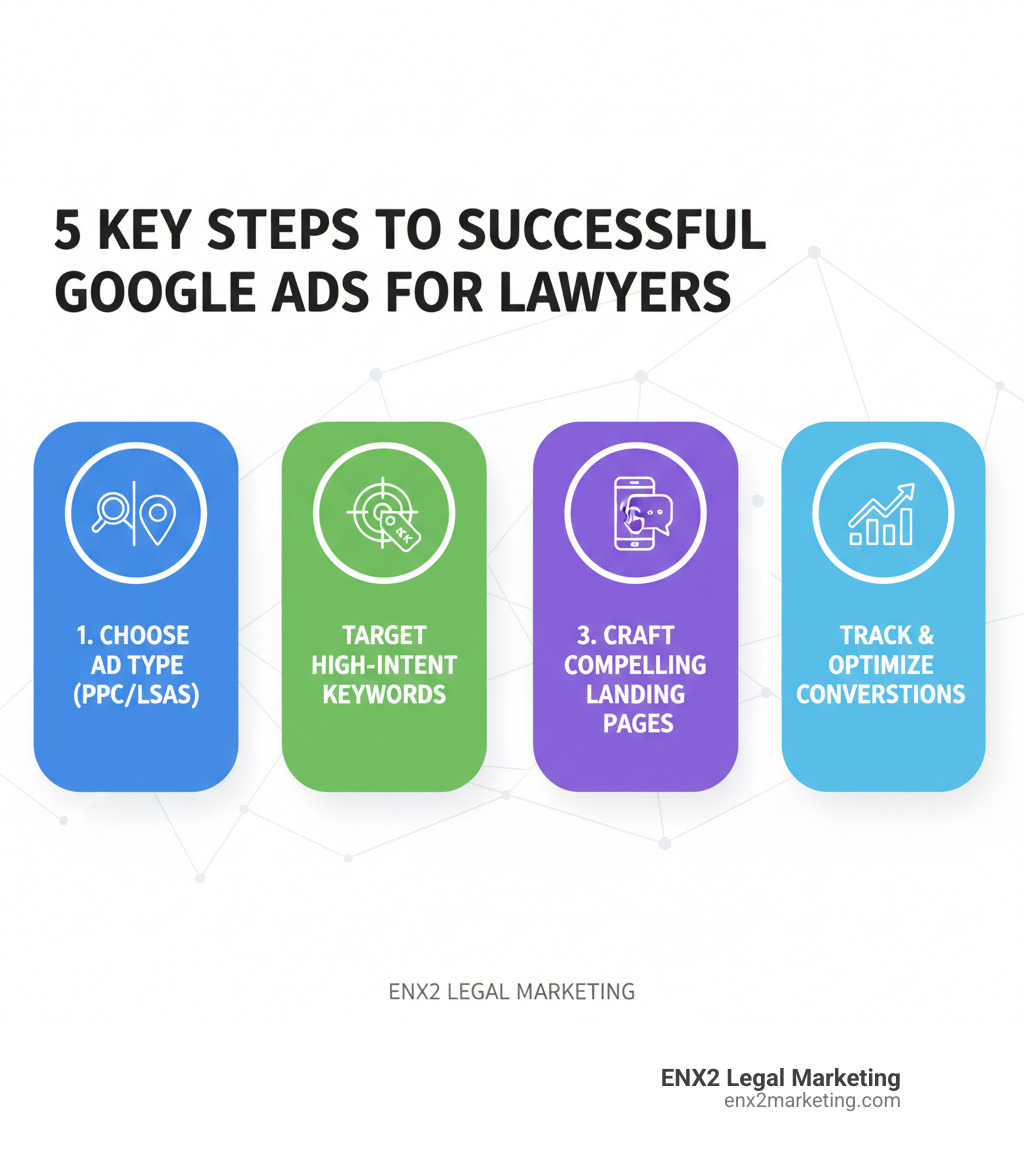
Utilizing Location-Based Targeting for Local Clients
Location-based targeting is crucial for attorneys aiming to attract local clients. By setting geographic parameters, legal practitioners can ensure their ads reach individuals actively seeking legal assistance in specific areas. For instance, targeting a 10-mile radius around a law office can significantly increase the relevance of clicks.
- Geographic targeting: Use Google Ads’ location settings to select cities, regions, or even specific zip codes.
- Location bid adjustments: Increase bids for locations with higher conversion rates.
- Local service ads: Consider using Google’s Local Services Ads for enhanced visibility in local searches.
Leveraging Audience Insights for Tailored Messaging
Understanding the target audience is essential for crafting effective ad copy. Google Ads provides various audience insights that can help attorneys tailor their messaging based on demographics, interests, and behaviors. For example, focusing on first-time homebuyers can attract clients needing real estate legal services.
- Demographic targeting: Adjust campaigns based on age, gender, and household income.
- In-market audiences: Target users actively searching for legal services relevant to your practice area.
- Custom audiences: Create lists based on previous client interactions or site visitors.
Incorporating Negative Keywords to Filter Traffic
Negative keywords prevent ads from showing up for irrelevant searches, enhancing the quality of traffic. For attorneys, using negative keywords can filter out terms that do not align with their services, thereby reducing wasted ad spend. For instance, if a firm specializes in personal injury law, adding “free consultation” as a negative keyword may help focus on more serious inquiries.
Using Remarketing to Re-Engage Potential Clients
Remarketing is an effective strategy for attorneys to re-engage potential clients who have previously interacted with their website. By displaying targeted ads to users who have shown interest, firms can encourage them to revisit and ultimately convert. Data indicates that remarketing can increase conversion rates by up to 50% when executed correctly.
Nuance / Expert Layer
Many attorneys underestimate the importance of audience segmentation within their campaigns. While broad targeting may seem advantageous, it often leads to ineffective ad spend. Instead, creating specific segments based on client profiles can yield better results. For instance, a family law attorney may benefit from separate campaigns for divorce and child custody cases, each with tailored messaging that resonates with distinct client needs.
Practical Application
To implement these advanced targeting strategies, attorneys should:
- Set up geographic targeting to focus on local clients.
- Utilize audience insights to refine ad messaging based on demographics and interests.
- Incorporate negative keywords to enhance ad relevance and reduce costs.
- Implement remarketing strategies to reconnect with potential clients who have engaged with your website.
Analyzing and Optimizing Your Google Ads Campaign
This section provides a detailed approach to measuring the success of Google Ads campaigns specifically tailored for attorneys. By focusing on key performance indicators and optimization techniques, legal professionals can enhance their visibility and client acquisition effectively.

Understanding Key Performance Indicators (KPIs)
Key performance indicators are essential metrics that help attorneys evaluate the effectiveness of their Google Ads campaigns. Important KPIs include:
- Click-Through Rate (CTR): The percentage of users who click on your ad after seeing it. A higher CTR indicates effective ad copy.
- Conversion Rate: The percentage of visitors who take a desired action, such as filling out a contact form. A conversion rate of 5-10% is often considered good in the legal sector.
- Cost Per Acquisition (CPA): The total cost of acquiring a new client through your ads. For attorneys, a typical CPA can range from $50 to $300, depending on the practice area.
A/B Testing Ad Copies and Landing Pages
A/B testing, or split testing, is a method where two versions of an ad or landing page are compared to determine which performs better. This process allows attorneys to fine-tune their messaging and design. Consider the following steps:
- Create two variations of your ad copy or landing page, changing only one element (e.g., headline, call to action).
- Run both ads simultaneously to a similar audience for a set period.
- Analyze the results to identify which version yielded a higher conversion rate.
Regular A/B testing can lead to incremental improvements, significantly affecting overall campaign performance over time.
Adjusting Bids Based on Performance Data
Bid adjustments should be based on the performance of specific keywords and ads. Utilize Google Ads’ automated bid strategies to optimize your budget allocation efficiently. For example, consider increasing bids for high-performing keywords that generate a strong conversion rate, while reducing bids for underperforming keywords. This strategic allocation can enhance your return on investment (ROI).
Utilizing Google Analytics for Deeper Insights
Integrating Google Analytics with your Google Ads account provides comprehensive insights into user behavior on your website. Key aspects to monitor include:
- User Engagement: Metrics such as average session duration and bounce rate help assess the quality of your traffic.
- Traffic Sources: Understanding where your visitors come from can inform your advertising strategy.
- Goal Completions: Tracking specific actions, such as form submissions or phone calls, allows for precise measurement of campaign effectiveness.
In 2024, legal firms that effectively leverage Google Ads with integrated analytics report up to a 30% increase in client inquiries, demonstrating the power of data-driven decision-making.
Nuance / Expert Layer
Many attorneys mistakenly believe that simply increasing their ad spend will lead to better results. However, without optimizing ad copy, targeting, and landing pages, increased budgets can lead to wasted spend. Moreover, focusing solely on CPC (cost-per-click) can be misleading; it is crucial to consider the entire customer journey and the value each client brings to your practice over time. Implementing a holistic approach to campaign management is essential for sustained success.
Practical Application
To enhance your Google Ads for attorneys, begin by identifying and monitoring your key performance indicators. Implement A/B testing to refine your ad copy and landing pages continually. Adjust your bids based on data-driven insights to maximize ROI. Finally, integrate Google Analytics to deepen your understanding of visitor behavior and campaign performance. Regularly review and adapt your strategy based on these insights to stay competitive in the legal market.
Integrating Google Ads with Your Overall Marketing Strategy
Effectively integrating Google Ads into a law firm’s marketing strategy enhances visibility and client acquisition. This section explores how to align Google Ads with other marketing efforts for maximum impact.

Aligning Google Ads with SEO Efforts
Google Ads and search engine optimization (SEO) should work in tandem to create a comprehensive online presence. While Google Ads provides immediate visibility, SEO develops organic traffic over time. By integrating both strategies, law firms can capitalize on the strengths of each.
- Keyword Consistency: Use similar keywords across both platforms to reinforce brand messaging.
- Data Sharing: Leverage insights from Google Ads to refine SEO strategies, adjusting content based on high-performing ad keywords.
- Landing Page Optimization: Ensure that landing pages from Google Ads are optimized for organic traffic to enhance user experience and improve conversion rates.
Using Content Marketing to Support Ad Campaigns
Content marketing plays a vital role in complementing Google Ads efforts. Quality content can establish a law firm’s authority and drive organic traffic, which supports paid campaigns.
- Blog Posts: Create informative articles that address common legal questions, linking them to Google Ads campaigns.
- Guides and E-books: Offer downloadable resources that require users to enter their email, allowing for remarketing through Google Ads.
- Video Content: Use videos to explain legal processes, which can be promoted through Google Ads for wider reach.
Integrating Social Media for a Cohesive Strategy
Social media platforms can amplify the reach of Google Ads campaigns. By creating a cohesive strategy, law firms can ensure that messaging is consistent across channels, enhancing brand recognition.
- Cross-Promotion: Share Google Ads promotions on social media to drive traffic and engagement.
- Audience Targeting: Utilize audience insights from social media to refine Google Ads targeting, ensuring ads reach the right demographics.
- Engagement Tracking: Monitor social media interactions to inform and adjust Google Ads campaigns based on audience interests.
Building a Strong Call-to-Action Across Platforms
A compelling call-to-action (CTA) is essential for converting leads across all marketing channels. Consistency in CTAs across Google Ads, social media, and content marketing enhances effectiveness.
- Clear Messaging: Ensure that CTAs are straightforward and convey urgency, prompting immediate action.
- Visibility: Place CTAs prominently on landing pages, social media posts, and within content to maximize interaction.
- A/B Testing: Regularly test different CTAs to determine which versions yield the highest conversion rates.
Many firms overlook the synergy between Google Ads and other marketing strategies. A common misconception is that paid ads alone will suffice for visibility. In reality, a multi-channel approach, including SEO, content marketing, and social media, enhances overall effectiveness. For instance, law firms that integrate these strategies report an average increase of 30% in lead conversions. This integrated approach not only broadens reach but also fosters trust and credibility among potential clients.
To effectively implement these strategies, attorneys should start by conducting a thorough audit of their current marketing efforts. Identify overlapping keywords, create relevant content that supports ad campaigns, and ensure social media messaging aligns with Google Ads. Finally, develop consistent CTAs across all platforms to drive engagement and conversions. This holistic approach will maximize the effectiveness of google ads for attorneys, converting clicks into clients.
Evaluating the Best Google Ads For Attorneys
As the legal sector continues to grow, with an estimated market size of $900 billion by 2026, law firms must strategically evaluate their advertising options. Comparing various providers is crucial to identify the most effective platform for reaching potential clients. Key criteria include pricing, target audience, and specialized features that cater to the legal industry.
| Provider / Option | Best For | Pricing | Key Feature |
|---|---|---|---|
| Google Ads | All sizes of law firms | $1-$2 per click on average | Extensive reach and targeting options |
| Bing Ads | Cost-effective alternative | $0.50-$1.50 per click | Lower competition in legal niche |
| LawLytics | Solo attorneys and small firms | $200/month plus ad spend | Tailored specifically for law firms |
| AdWords for Lawyers | Comprehensive campaign management | $300/month plus ad spend | Legal-specific ad strategies |
| Justia Ads | Personal injury and criminal law | $500/month plus ad spend | Focus on legal niches |
Criteria for Evaluating Program Quality
- Pricing: Consider the cost per click or monthly fees, ensuring it aligns with your budget and expected return on investment. Understanding the pricing structure is essential for effective budgeting.
- Target Audience: Evaluate whether the provider can reach your specific target demographic. Different platforms may have varying effectiveness based on the legal services offered.
- Key Features: Assess the unique features each provider offers, such as targeting options and campaign management tools that cater specifically to law firms.
- Support and Resources: Consider the level of customer support and educational resources available. A provider that offers assistance and guidance can significantly enhance campaign success.
How to Assess the Reputation and Reliability of Providers
- Research Reviews: Look for client testimonials and case studies to gauge the effectiveness of the provider’s services.
- Check Industry Credentials: Verify if the provider is recognized in the legal advertising space through certifications or industry awards.
- Ask for References: Request references from current or past clients to gain insights into their experiences and results.
- Evaluate Transparency: Ensure the provider is transparent about their pricing, processes, and performance metrics to build trust.
- Trial Period: Consider providers that offer a trial period or demo, allowing you to assess their platform’s suitability before committing.
Which Google Ads For Attorneys Is Right for You?
Choosing the right Google Ads solution for attorneys hinges on your specific business needs, budget, and marketing goals. This decision guide breaks down tailored recommendations for various audience segments to help you make an informed choice.
Solo attorneys
Solo attorneys should consider using LawLytics, which offers tailored solutions designed to fit your budget and specific needs. With plans averaging between $100 to $300 per month, LawLytics provides an easy-to-use platform that focuses on content marketing alongside Google Ads, ensuring your online presence is both effective and economical.
Small law firms
For small law firms, leveraging Google Ads is essential for comprehensive targeting and increasing visibility in local markets. Setting a budget of $500 to $1,500 per month allows you to create targeted campaigns that reach potential clients in your geographic area, maximizing your return on investment through focused keyword strategies and ad placements.
Mid-sized firms
Mid-sized firms can benefit from exploring Bing Ads as a cost-effective alternative to Google Ads, especially given the lower competition on the platform. With a monthly budget of around $300 to $800, firms can effectively capture leads while enjoying lower cost-per-click rates compared to Google, making it a viable option for expanding reach without overspending.
Large law firms
Large law firms should invest in AdWords for Lawyers, which provides advanced campaign management and specialized legal expertise. Budgeting $2,000 or more per month allows for sophisticated targeting strategies and analytics, ensuring that your campaigns are optimized for high-value conversions and tailored to the nuances of legal marketing.
| If You Are… | Best Approach |
|---|---|
| Solo attorneys | Use LawLytics for tailored solutions ($100-$300/month). |
| Small law firms | Consider Google Ads ($500-$1,500/month) for local visibility. |
| Mid-sized firms | Explore Bing Ads ($300-$800/month) for lower competition. |
| Large law firms | Invest in AdWords for Lawyers ($2,000+/month) for advanced management. |
Local Strategies for Google Ads Targeting Attorneys
Understanding geographic and local market dynamics is crucial for attorneys leveraging Google Ads. In fact, 46% of all Google searches are seeking local information, highlighting the importance of targeting specific communities. Localized advertising can significantly boost conversion rates, especially when tailored to the unique needs of a given market.
Geographic Market Differences
The effectiveness of google ads for attorneys can vary widely between urban and rural settings. For instance, attorneys in metropolitan areas like Los Angeles or New York City face intense competition, requiring more aggressive bidding strategies and tailored ad copy. Conversely, in smaller markets, attorneys may benefit from lower cost-per-click (CPC) rates and less competition, allowing for more budget-friendly campaigns.
Local Business Applications
Local attorneys can capitalize on Google Ads in specific ways that differ from national firms. Consider the following applications:
- Targeted Keywords: Use geo-specific keywords such as “divorce attorney in Austin” to attract local clients.
- Ad Extensions: Implement location extensions to display your office address and phone number, enhancing local visibility.
- Call-Only Campaigns: Create ads focused on phone calls, ideal for clients needing immediate legal assistance.
- Localized Landing Pages: Develop landing pages that speak directly to local legal issues, improving relevance and conversion rates.
Local Search and Visibility Impact
Google Ads directly influences local search rankings and the visibility of your Google Business Profile (GBP). To maximize this impact, local attorneys should take the following actions:
- Optimize your Google Business Profile with accurate NAP (Name, Address, Phone) information.
- Utilize local keywords in both ads and website content to align with local search intent.
- Encourage client reviews on your GBP, as positive feedback improves local rankings.
- Monitor performance metrics closely, adjusting bids and keywords based on local search trends.
Pricing and Cost in Local Markets
Advertising costs for Google Ads can vary significantly based on geographic location. For example, attorneys in competitive markets like Miami may see CPC rates ranging from $10 to $30, while those in less saturated areas might experience rates as low as $4 to $10. Local businesses should budget around $1,000 to $3,000 per month for effective campaigns, while national firms may allocate significantly more to maintain visibility across multiple regions.
Local Implementation Checklist:
- Research local keywords relevant to your legal practice.
- Set up location targeting in your Google Ads account.
- Create localized ad copy that resonates with your community.
- Implement call tracking to measure the effectiveness of phone inquiries.
- Regularly update your Google Business Profile with accurate information.
- Monitor competitors’ ads and adjust your strategy accordingly.
- Analyze conversion data to refine your campaigns continuously.
For law firms looking to generate local leads through Google Ads or Local SEO, GMB Ranger LLC offers hands-on campaign management. Specialist Md Tangeer Mehedi personally handles campaign setup and ongoing optimization — with no payment required until the first lead comes in.
Frequently Asked Questions
What are Google Ads for attorneys?
Google Ads for attorneys are paid online advertisements that help law firms reach potential clients searching for legal services. These ads appear on Google’s search results pages and can target specific keywords relevant to legal practice areas.
How do I set up Google Ads for my law firm?
To set up Google Ads for a law firm, create a Google Ads account and define your campaign goals. Select relevant keywords, create compelling ad copy, and set a budget to start attracting clients.
What is the average cost of Google Ads for attorneys?
The average cost of Google Ads for attorneys can vary widely, typically ranging from $2 to $10 per click depending on the competition in your area. Budgeting effectively is crucial to maximize your return on investment.
How effective are Google Ads for law firms?
Google Ads can be highly effective for law firms, often generating leads and inquiries from potential clients actively searching for legal assistance. Success depends on targeting the right keywords and optimizing ad performance.
What are common mistakes to avoid in Google Ads for attorneys?
Common mistakes include targeting overly broad keywords, neglecting ad copy quality, and failing to monitor campaign performance. Regular analysis and adjustments are essential to improve the effectiveness of your Google Ads strategy.
Final Thoughts on google ads for attorneys
Leveraging Google Ads effectively can dramatically enhance a law firm’s visibility and client acquisition efforts. By implementing advanced targeting strategies and continuously optimizing campaigns, attorneys can ensure they not only reach potential clients but also convert them into loyal customers.
To maximize your return on investment, conduct a thorough analysis of your current advertising performance and refine your keyword strategy to focus on high-converting terms specific to your legal niche.
Ready to take your legal practice to the next level? Consider partnering with a google ads management agency to maximize your reach and attract more clients.
In an increasingly competitive legal landscape, mastering Google Ads is not just beneficial—it’s essential for sustained growth and success.
Leave a Reply