

Google Ads for law firm marketing involves creating targeted ad campaigns on Google to attract potential clients. This digital advertising platform enables law firms to reach specific demographics and monitor performance metrics for ongoing optimization.
Understanding Google Ads is crucial for law firms seeking to enhance their online visibility and client acquisition efforts. Missteps in campaign management can lead to wasted budgets and missed opportunities, making it essential for legal professionals to grasp the intricacies of this marketing tool.
This guide covers key strategies for setting up effective Google Ads campaigns, optimizing ad performance, and analyzing results to ensure maximum return on investment for law firm marketing efforts.
For law firms looking to generate local leads through Google Ads, GMB Ranger LLC offers hands-on campaign management. Specialist Md Tangeer Mehedi personally handles campaign setup and ongoing optimization — with no payment required until the first lead comes in.
What are Google Ads for law firm marketing?
Google Ads for law firm marketing are paid advertisements that appear on Google search results and other Google properties, specifically targeting potential clients searching for legal services. These ads enable law firms to promote their services effectively by reaching individuals actively seeking legal assistance. By utilizing Google Ads, law firms can enhance their online visibility and attract more qualified leads.
Google Ads operate on a pay-per-click (PPC) model, meaning that law firms only pay when a user clicks on their ad. This approach allows for precise budget control and targeted outreach. Within Google Ads, law firms can create campaigns tailored to specific practice areas, such as personal injury, family law, or criminal defense, ensuring that the right audience sees their advertisements. Additionally, leveraging geographic targeting can help firms reach potential clients in their local area.
- Search Ads: Text-based ads displayed on Google search results when users search for specific keywords related to legal services.
- Display Ads: Visual ads that appear on websites within Google’s Display Network, which can help raise brand awareness.
- Video Ads: Ads shown on platforms like YouTube, suitable for storytelling and showcasing client testimonials or legal insights.
To maximize the effectiveness of Google Ads, law firms should focus on creating compelling ad copy and utilizing relevant keywords that potential clients are likely to search. Regularly analyzing ad performance and adjusting strategies based on data can significantly improve return on investment (ROI).
Expert Tip: Consider implementing conversion tracking to measure the effectiveness of each ad campaign. This data-driven approach allows law firms to refine their strategies, ensuring that marketing budgets are allocated efficiently to the most successful campaigns.
How do I set up Google Ads for my law firm?
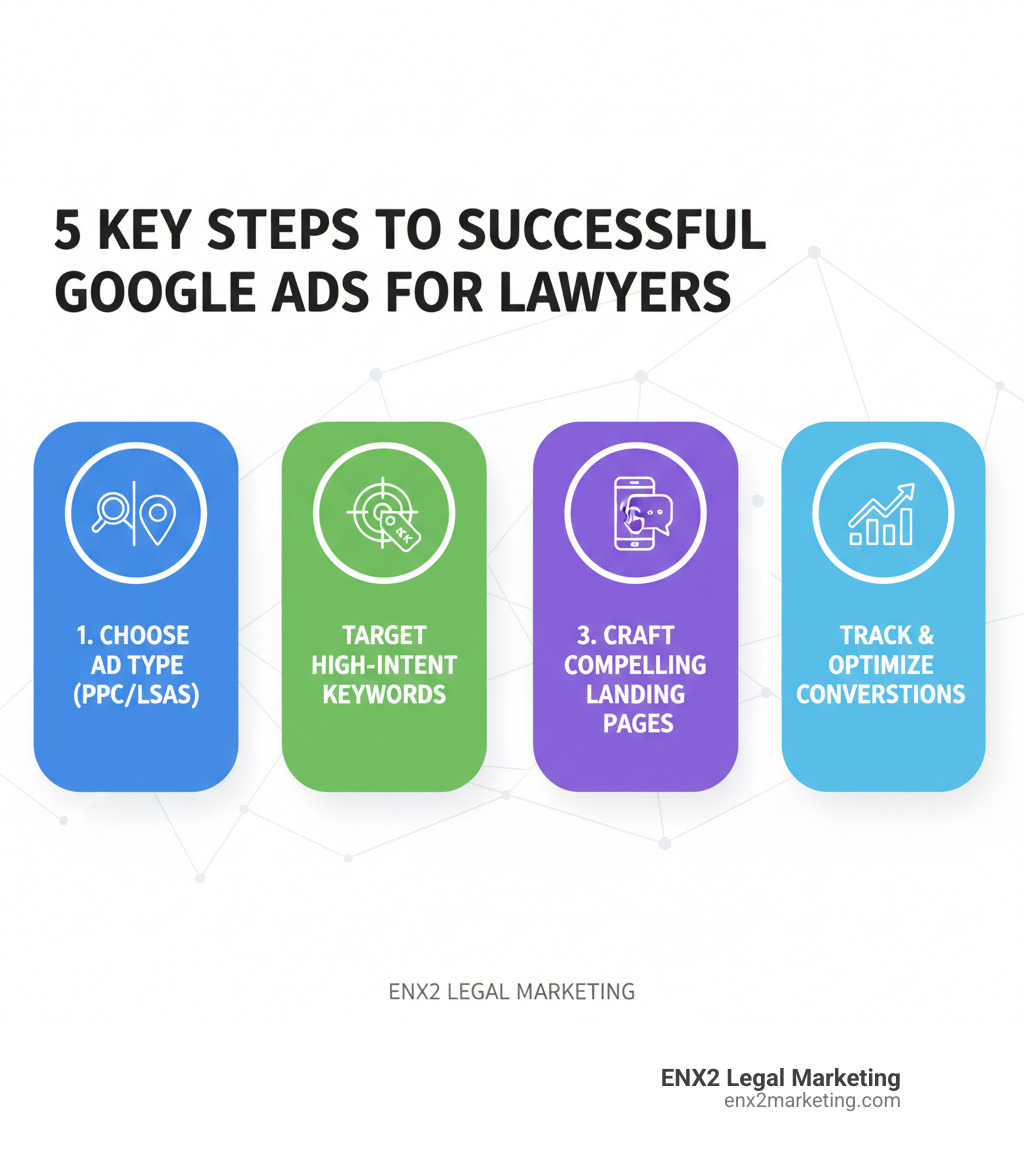
Setting up Google Ads for a law firm involves creating an account, configuring campaigns, and optimizing ads to target potential clients effectively. Follow the steps below to establish your Google Ads presence tailored specifically for legal marketing.
- Create a Google Ads Account: Visit the Google Ads website and sign up for an account. Provide necessary information such as your email, website, and billing details.
- Define Your Goals: Determine what you want to achieve with your ads, whether it’s generating leads, increasing calls, or driving traffic to your website. Clear goals will guide your campaign structure.
- Conduct Keyword Research: Use tools like Google Keyword Planner to identify relevant keywords that potential clients might use. Focus on local and practice-area-specific keywords to enhance relevancy.
- Create Campaigns and Ad Groups: Organize your campaigns based on specific legal services offered, such as personal injury or family law. Each campaign should contain ad groups with closely related keywords.
- Write Compelling Ad Copy: Craft ads that speak directly to your target audience. Highlight unique selling points, include a strong call to action, and ensure compliance with legal advertising regulations.
- Set Your Budget and Bidding Strategy: Decide on a daily budget and choose a bidding strategy, such as manual CPC or automated bidding, that aligns with your campaign goals.
- Launch Your Campaign: Review all settings and launch your campaign. Monitor performance closely in the first few weeks to make necessary adjustments.
- Optimize and Analyze: Regularly review your campaign’s performance metrics. Adjust keywords, ad copy, and bidding strategies based on data to improve results over time.
For law firms, continually refining your Google Ads strategy is vital. Stay updated on changes in legal advertising regulations and adapt your campaigns accordingly to ensure compliance and effectiveness.
Expert Tip: Utilize ad extensions, such as call extensions and location extensions, to enhance your ads’ visibility and provide potential clients with immediate contact options, increasing engagement and conversions.
What is the average cost of Google Ads for law firms?
The average cost of Google Ads for law firms typically ranges from $2 to $10 per click, depending on various factors. On a monthly basis, law firms can expect to spend anywhere from $1,000 to $10,000 or more, based on their advertising goals and market competition.
Several factors influence these costs, including the following:
- Geographic Location: Advertising costs vary significantly by region. Urban areas with higher competition may incur higher costs per click compared to rural locations.
- Practice Area: Different legal specialties have different levels of competition. For example, personal injury and criminal defense often have higher CPC rates than family law.
- Quality Score: Google assigns a quality score based on the relevance of ads and landing pages. A higher quality score can lead to lower costs per click.
- Ad Competition: The number of law firms bidding on similar keywords directly impacts cost. More competition generally results in higher bids.
- Ad Budget: The overall budget set by the law firm can affect the visibility and frequency of the ads. A higher budget allows for more aggressive bidding strategies.
Understanding these factors is essential for law firms aiming to optimize their Google Ads campaigns. By analyzing their specific circumstances, firms can better predict costs and strategize effectively.
Expert Tip: Regularly reviewing and adjusting keyword strategies based on performance data can enhance ROI. Focus on long-tail keywords to target specific client needs while potentially lowering costs.
What are the best practices for Google Ads in legal marketing?
Implementing effective Google Ads strategies is essential for law firms seeking to enhance their online visibility and attract potential clients. Best practices encompass various tactics that optimize ad performance, increase click-through rates, and improve conversion rates. Law firms should focus on targeted campaigns, relevant messaging, and continuous performance analysis.
First, keyword selection is critical. Conduct thorough keyword research to identify terms potential clients use when seeking legal services. Utilize tools like Google Keyword Planner to find high-volume, low-competition keywords specific to your practice areas. This will help in crafting targeted ads that resonate with your audience.
- Utilize ad extensions: Incorporate site link, call, and location extensions to enhance your ads’ visibility and provide more information. These extensions can increase click-through rates by making your ads more informative and engaging.
- Focus on ad copy: Write compelling ad copy that highlights your unique selling propositions and includes a strong call to action. Ensure it addresses the specific needs of your target audience, whether they are looking for personal injury representation or family law services.
- Optimize landing pages: Ensure that the landing pages linked to your ads are relevant, user-friendly, and optimized for conversions. Clear calls to action, concise information, and easy navigation can significantly boost your conversion rates.
- Monitor and adjust campaigns: Regularly analyze your campaigns’ performance metrics. Focus on click-through rates, conversion rates, and quality scores to identify areas for improvement. Adjust bids, keywords, and ad copy based on this data to enhance effectiveness.
Expert Tip: Implementing A/B testing for different ad copies and landing pages can provide insights into what resonates best with your audience. This data-driven approach allows for more strategic adjustments, leading to improved campaign performance over time.
How effective are Google Ads for law firm marketing compared to SEO?
Google Ads can provide immediate visibility and lead generation for law firms, while SEO focuses on long-term organic growth. Both strategies have unique benefits and drawbacks that can impact their effectiveness depending on a firm’s specific goals and circumstances.
Google Ads offers the advantage of quick results. Law firms can appear at the top of search results almost instantly after launching a campaign. This is particularly beneficial for firms looking to attract clients for urgent legal needs. However, Google Ads requires a continuous budget, and costs can escalate quickly, especially in competitive markets. Additionally, once the budget is exhausted, visibility vanishes.
On the other hand, SEO is a long-term investment. It involves optimizing a website to rank organically in search results, which can lead to sustainable traffic and credibility. While it may take time to see results, the traffic generated from SEO can be more cost-effective over time. However, maintaining these rankings requires ongoing effort and content creation, as well as adaptation to algorithm changes. The initial setup and optimization can also be resource-intensive.
- Cost: Google Ads incurs immediate costs with pay-per-click, while SEO costs are often tied to content creation and ongoing optimization.
- Speed: Google Ads delivers quick visibility, whereas SEO requires time to build authority and rankings.
- Sustainability: SEO can provide lasting traffic without ongoing costs, whereas Google Ads stops generating leads once the budget is depleted.
Firms should consider their marketing goals and budget constraints when deciding between Google Ads and SEO. A hybrid approach, utilizing both strategies, can often yield the best results, combining immediate leads with long-term authority and visibility.
Expert Tip: Regularly analyze performance metrics from both Google Ads and SEO efforts. Adjusting strategies based on real data can significantly enhance overall marketing effectiveness for law firms.
How long does it take to see results from Google Ads for a law firm?
Typically, law firms can expect to see initial results from Google Ads within 4 to 6 weeks of launching a campaign. However, achieving optimal performance may take 3 to 6 months, depending on various factors.
Several factors influence the timeline for seeing results from Google Ads. First, the competitiveness of the legal niche plays a significant role. In highly competitive areas, it may take longer to rank for desirable keywords, as more firms vie for the same audience. Additionally, the quality and relevance of the ads themselves can affect how quickly results materialize. Well-crafted ads that align closely with user intent often yield faster results.
Budget allocation is another critical factor. A higher budget allows for more extensive testing and quicker data collection, which can lead to faster optimization of campaigns. Conversely, limited budgets may slow the process of gathering actionable insights. Furthermore, ongoing adjustments and optimizations based on performance data are essential for achieving sustained results over time.
Finally, the geographic targeting and specific legal services offered can also impact timelines. Firms targeting local markets may see results sooner, while those targeting broader regions might experience delays as they establish brand recognition and credibility.
Expert Tip: Regularly monitor and analyze campaign performance metrics. This allows for timely adjustments, making it possible to accelerate the path to achieving desired outcomes in your Google Ads strategy.
What common mistakes should law firms avoid in Google Ads?
Law firms often make several common mistakes in Google Ads that can hinder their marketing effectiveness. These include poor keyword selection, lack of ad relevancy, and inadequate tracking of campaign performance. Avoiding these pitfalls is essential for maximizing ROI and attracting the right clients.
One frequent error is choosing overly broad keywords without considering their relevance to specific legal services. For instance, a personal injury law firm might bid on the keyword “lawyer” instead of more targeted terms like “car accident attorney” or “slip and fall lawyer.” This approach can lead to high costs with minimal conversions, as the ads attract clicks from users who may not be seeking the firm’s specific services.
Another common mistake is failing to create tailored ad copy that resonates with the target audience. For example, if a law firm advertises general legal services in its ads, potential clients may not feel compelled to click. Instead, the firm should craft ads that highlight unique selling points, such as free consultations or successful case outcomes. A well-structured ad that speaks directly to the needs of potential clients can significantly improve click-through rates and conversions.
Lastly, neglecting to track and analyze ad performance is a significant oversight. Without monitoring metrics like click-through rates (CTR) and conversion rates, law firms miss opportunities for optimization. For instance, if a firm notices that ads for “divorce attorney” are performing well, they can allocate more budget to this keyword while pausing underperforming terms.
Expert Tip: Utilize A/B testing for ad copy and landing pages to determine what resonates best with your audience. Regularly optimizing your campaigns based on performance data will enhance the effectiveness of your Google Ads strategy.
Advanced Targeting Strategies for Law Firms
This section explores advanced targeting techniques that enhance the effectiveness of Google Ads for law firm marketing. By employing these strategies, firms can refine their outreach and connect with potential clients more effectively.
Utilizing Demographic Targeting
Demographic targeting allows law firms to reach specific client profiles based on characteristics such as age, gender, and household income. By analyzing existing client data, firms can identify the demographics that are most likely to seek their services. For instance, a family law firm may focus on individuals aged 30-50, while a personal injury firm might target younger adults who are more likely to be involved in accidents.
Implementing Remarketing Strategies
Remarketing is a powerful tool for law firms to re-engage users who have previously visited their websites. By displaying targeted ads to these users as they browse other sites, firms can remind potential clients of their services. This strategy can significantly increase conversion rates, as these individuals are already familiar with the firm. Setting up remarketing lists based on user behavior, such as page visits or time spent on the site, ensures ads are displayed to the most interested audiences.
Leveraging Location-Based Targeting
Location-based targeting is essential for local law firms aiming to attract clients in specific geographic areas. Google Ads allows firms to set radius targeting, ensuring ads are shown only to users within a defined distance from the firm’s office. Additionally, using location-specific keywords can enhance visibility in local searches. For example, a firm in Miami should incorporate keywords like “Miami personal injury lawyer” to capture relevant traffic.
Using Negative Keywords
Negative keywords play a critical role in filtering out irrelevant traffic. By identifying terms that do not align with the firm’s services, law firms can prevent their ads from appearing in searches that are unlikely to convert. For instance, if a firm specializes in divorce law, adding “free” or “DIY” as negative keywords can help avoid attracting users looking for non-professional services. This not only improves click-through rates but also optimizes the ad budget.
Nuance and Expert Layer
A common misconception is that broad targeting strategies yield better results. However, precision is key in the legal sector. For example, a law firm might think they should cast a wide net with general terms, but such an approach can lead to high costs and low conversion rates. Instead, focusing on niche markets and tailoring campaigns to specific legal issues or client needs often proves more effective. Additionally, combining demographic targeting with behavioral insights can create highly customized ad experiences that resonate with potential clients.
Practical Application
- Analyze client demographics and adjust Google Ads settings to reflect these insights.
- Set up remarketing campaigns to target users who have previously engaged with the website.
- Implement radius targeting to ensure ads reach local audiences effectively.
- Regularly review and update negative keywords to eliminate irrelevant traffic.
By applying these advanced targeting strategies, law firms can enhance their Google Ads campaigns, driving more qualified traffic and ultimately increasing client acquisition.
Measuring Success: Key Metrics for Law Firm Google Ads
This section delves into the critical metrics that define the effectiveness of Google Ads campaigns for law firms. By focusing on measurable outcomes, firms can refine their strategies to enhance client acquisition and optimize advertising spend.
Understanding Conversion Tracking
Conversion tracking is the process of measuring specific actions taken by users after interacting with a Google Ads campaign. For law firms, these actions may include filling out a contact form, scheduling a consultation, or downloading legal resources. Implementing conversion tracking allows firms to pinpoint which ads are driving valuable client interactions, ultimately informing future marketing decisions.
Identifying Key Performance Indicators (KPIs)
Establishing clear KPIs is essential for evaluating the performance of Google Ads campaigns. Law firms should focus on the following metrics:
- Conversion Rate: The percentage of users who complete a desired action after clicking on an ad.
- Return on Investment (ROI): Measures the profit generated from ad spend relative to the cost of the campaigns.
- Quality Score: A Google metric that assesses the relevance and quality of ads, keywords, and landing pages.
Analyzing Click-Through Rates (CTR) and Cost-Per-Click (CPC)
Click-Through Rate (CTR) indicates the effectiveness of an ad in attracting clicks. A higher CTR suggests that the ad is relevant and compelling to the target audience. Conversely, Cost-Per-Click (CPC) represents the amount spent for each click on an ad. Monitoring these metrics helps law firms assess their advertising efficiency and budget allocation. An ideal scenario combines a high CTR with a low CPC, maximizing reach while minimizing costs.
Using A/B Testing to Optimize Ad Performance
A/B testing involves running two variations of an ad to determine which performs better. This method allows law firms to fine-tune their messaging, visuals, and calls to action based on real-world data. Steps for effective A/B testing include:
- Identify a single variable to test, such as ad copy or image.
- Run both ad variations simultaneously to a similar audience.
- Analyze performance metrics over a set period to determine the winning ad.
Common misconceptions about A/B testing include the belief that testing requires large budgets or extensive timeframes. In reality, even minor adjustments can yield significant insights, and tests can be conducted over a short duration to capture immediate data.
Law firms should focus on actionable metrics that directly impact their advertising goals. Regularly review these key performance indicators and adjust campaigns based on insights gained from conversion tracking, CTR, CPC, and A/B testing. Implementing these strategies will enhance the effectiveness of Google Ads for law firm marketing and lead to improved client engagement and acquisition.
Real-World Case Studies: Success Stories of Law Firms Using Google Ads
This section examines successful Google Ads campaigns executed by law firms, showcasing effective strategies and their outcomes. These case studies provide actionable insights and highlight industry trends that can inform future marketing efforts.

Case Study 1: Smith & Johnson Law Firm
Smith & Johnson Law Firm, specializing in personal injury cases, implemented a targeted Google Ads campaign focusing on local search terms. Their strategy included the use of geo-targeting to reach potential clients in specific zip codes where they had seen the highest case volume.
- Utilized ad extensions to display phone numbers and location.
- Emphasized testimonials and case results in ad copy.
- Set a budget cap to control spending while maximizing reach.
As a result, the firm reported a 35% increase in client inquiries and a 20% rise in case sign-ups over a three-month period. This case demonstrates the effectiveness of localized targeting in Google Ads for law firm marketing.
Case Study 2: Bennett Family Law
Bennett Family Law, focusing on divorce and custody cases, adopted a content-driven approach by creating informative landing pages linked to their Google Ads. They featured articles addressing common client concerns, which significantly improved their Quality Score.
- Developed specific landing pages for different legal services.
- Incorporated relevant keywords based on client searches.
- Utilized remarketing strategies to reconnect with previous visitors.
This approach led to a 50% decrease in cost-per-click (CPC) and a 40% increase in conversions from their ads. The focus on quality content not only improved their ad performance but also established the firm as a trusted resource.
Lessons Learned from These Case Studies
Both case studies reveal key lessons for law firms considering Google Ads:
- Localization is key: Tailoring ads to specific geographic areas enhances relevance and engagement.
- Content matters: High-quality, informative content can improve ad performance metrics.
- Monitoring and adjusting: Regular analysis of ad performance allows for timely adjustments, optimizing the return on investment.
Industry Trends Observed
These success stories highlight several trends in the legal sector’s use of Google Ads:
- Increased adoption of video ads to enhance engagement.
- Growing emphasis on mobile optimization as more clients search on smartphones.
- Rising importance of online reviews and reputation management in ad copy.
While many firms focus solely on PPC strategies, a comprehensive approach that incorporates SEO, content marketing, and client engagement often yields superior results. Misconceptions about the effectiveness of Google Ads can lead firms to underestimate this powerful tool.
To leverage these insights, law firms should start by defining their target audience and geographic reach. Implementing localized campaigns and creating informative landing pages can optimize ad performance. Additionally, firms should regularly analyze data to refine their strategies, ensuring continuous improvement in client acquisition efforts.
For law firms looking to generate local leads through Google Ads, GMB Ranger LLC offers hands-on campaign management. Specialist Md Tangeer Mehedi personally handles campaign setup and ongoing optimization — with no payment required until the first lead comes in.
Frequently Asked Questions
What are Google Ads for law firm marketing?
Google Ads for law firm marketing are paid advertising campaigns that appear on Google’s search results and partner sites. They allow law firms to target specific keywords and demographics to attract potential clients actively searching for legal services.
How do I set up Google Ads for my law firm?
To set up Google Ads for a law firm, create a Google Ads account, define your campaign goals, and select relevant keywords. Then, design compelling ad copy and set a budget to launch your campaign targeting potential clients.
What is the average cost of Google Ads for law firms?
The average cost of Google Ads for law firms typically ranges from $2 to $6 per click, depending on the competition for specific keywords. Overall monthly budgets can vary widely based on the firm’s goals and market conditions.
What are the best practices for Google Ads in legal marketing?
Best practices for Google Ads in legal marketing include targeting specific keywords, using location-based targeting, and creating tailored ad copy that addresses client needs. Regularly monitoring and optimizing campaigns based on performance data is also crucial for success.
How effective are Google Ads for law firm marketing compared to SEO?
Google Ads can provide immediate visibility and leads, while SEO typically takes longer to yield results but offers long-term organic traffic. Both strategies can be effective, but combining them often yields the best overall results for law firm marketing.
How long does it take to see results from Google Ads for a law firm?
Results from Google Ads can often be seen within days of launching a campaign, as ads can appear almost immediately. However, optimizing campaigns for better performance may take several weeks of data analysis and adjustments.
What common mistakes should law firms avoid in Google Ads?
Common mistakes law firms should avoid in Google Ads include neglecting to use negative keywords, failing to track conversions, and not optimizing ad copy for relevancy. Additionally, setting unrealistic budgets or targeting overly broad keywords can lead to wasted ad spend.
Final Thoughts on Google Ads for Law Firm Marketing
Implementing Google Ads effectively can significantly enhance a law firm’s visibility, client acquisition, and overall marketing strategy. By leveraging advanced targeting strategies and measuring success through key metrics, law firms can optimize their campaigns to achieve impressive results and stay competitive in a crowded marketplace.
Law firms should conduct a comprehensive audit of their current marketing efforts and integrate targeted Google Ads campaigns that align with their specific practice areas, ensuring a focused approach that maximizes return on investment.
Mastering Google Ads is not just an option for law firms; it is essential for sustained growth and client engagement in a digital-first world.
Leave a Reply