
What are google ads for self storage?
Google Ads for self storage is a targeted advertising platform that enables storage facilities to enhance their online visibility and attract potential customers. When utilized effectively, businesses can achieve a return on investment (ROI) of up to 200%, making it a valuable tool for driving customer acquisition and revenue growth.
Understanding Google Ads for self storage is crucial for facility owners and marketers aiming to improve their advertising strategies in a competitive market. As the self storage industry continues to grow, with a projected market size exceeding $50 billion in the U.S. alone, leveraging digital advertising can significantly impact a business’s success. Failing to grasp the nuances of this platform can lead to missed opportunities and reduced market share.
Neglecting to effectively utilize Google Ads can result in substantial financial losses, wasted marketing budgets, and a competitive disadvantage against more savvy operators in the self storage sector. Without a strategic approach, businesses risk falling behind in customer engagement and overall profitability.
This article will explore the essentials of Google Ads for self storage, including a comparison of leading advertising providers, a detailed cost breakdown, best practices for campaign optimization, and insights into enhancing local SEO to attract more customers.
For Self Storage businesses looking to generate local leads through Google Ads or Local SEO, GMB Ranger LLC offers hands-on campaign management. Specialist Md Tangeer Mehedi personally handles campaign setup and ongoing optimization — with no payment required until the first lead comes in.
What are Google Ads for self storage?
Google Ads for self storage are online advertising campaigns specifically designed to promote self storage facilities through Google’s advertising platform. These ads target potential customers searching for storage solutions, enhancing visibility and driving traffic to the facility’s website or physical location.
Google Ads operate on a pay-per-click (PPC) model, meaning advertisers pay only when someone clicks their ad. For the self storage industry, this is particularly effective as it allows facilities to reach individuals actively seeking storage options. According to industry reports, 80% of consumers conduct online research before making a purchase decision, highlighting the importance of a robust online presence.
- Search Ads: Text-based ads that appear on Google search results when users search for relevant keywords, such as “self storage near me.”
- Display Ads: Visual ads that appear on websites within Google’s Display Network, aimed at users who may not be actively searching but fit certain demographics.
- Local Service Ads: Ads that target local customers, showing storage facilities based on proximity and including customer reviews and ratings for credibility.
Implementing Google Ads for self storage requires careful consideration of keyword selection, ad copy, and budget management. The effectiveness of ads can be influenced by factors such as seasonal demand fluctuations and geographic targeting. Additionally, optimizing landing pages to ensure a seamless user experience can significantly improve conversion rates.
Expert insight: Focus on local keywords and seasonal promotions to enhance ad relevance and drive higher engagement rates, ultimately maximizing return on investment.
How do I set up Google Ads for my self storage business?
Setting up Google Ads for a self storage business involves a series of structured steps that target potential customers effectively. A well-executed campaign can yield an average ROI of 200% or more, making it a crucial investment for facility owners.
Start by creating a Google Ads account. Visit the Google Ads website and sign up with your business email. Once your account is set up, navigate to the campaign creation section. Select the campaign type that suits your objectives; for self storage, consider “Search” campaigns, which target users actively searching for storage solutions. Set your campaign goals, such as website visits or phone calls, to guide your setup.
- Define your target audience: Identify demographics, interests, and locations relevant to your self storage services. This ensures your ads reach individuals most likely to need storage solutions.
- Keyword research: Use tools like Google Keyword Planner to find keywords related to self storage. Focus on terms with high search volume and low competition to optimize your ad visibility.
- Create compelling ad copy: Write clear, persuasive ad texts that highlight your unique selling propositions, such as security features, pricing, or special promotions. Include a strong call-to-action (CTA).
- Set your budget: Determine a daily budget that aligns with your marketing goals. Google Ads operates on a bidding system, so establish your maximum cost-per-click (CPC) for keywords.
- Design landing pages: Ensure the landing pages linked to your ads are optimized for conversions. They should load quickly, clearly display your offerings, and include easy navigation.
- Monitor and optimize: After launching your campaign, regularly check performance metrics such as click-through rates (CTR) and conversion rates. Adjust your keywords, ad copy, and budget based on performance data.
Expert insight: Utilize ad extensions to enhance visibility and engagement. Features like location, call, and site link extensions can significantly improve your ad’s performance and provide additional information to potential customers.
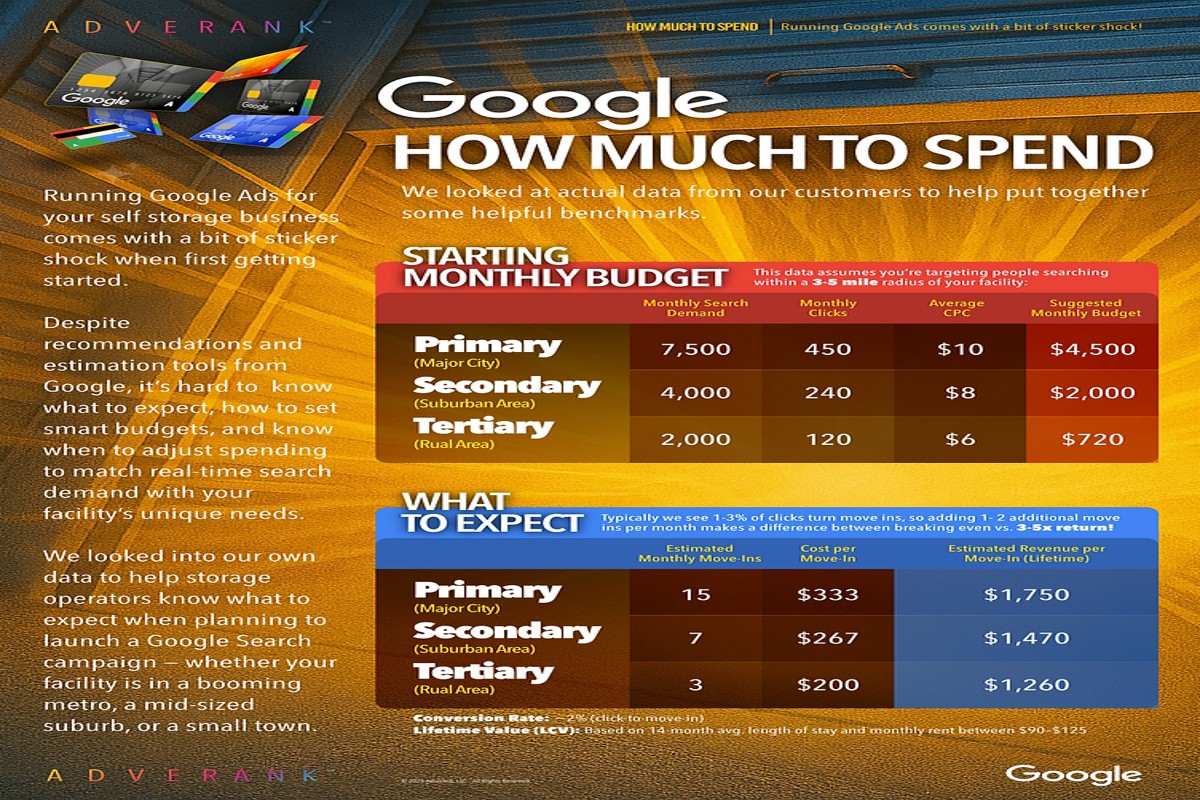
What is the cost of Google Ads for self storage?
The cost of Google Ads for self storage typically ranges from **$1 to $3 per click**. However, competitive markets can see costs rise to **$5 or more per click**. In 2024, the average cost-per-click (CPC) for self storage ads is projected to be around **$2.50**.
Several factors influence the cost of Google Ads for self storage. These include the competition in your area, the quality of your ads, and the bidding strategy you choose. Understanding these elements can help you manage your advertising budget effectively.
- Geographic location: Costs can vary significantly based on the market density and competition in your specific region. Urban areas tend to have higher CPCs due to increased competition.
- Keyword selection: The choice of keywords directly affects costs. High-demand keywords related to self storage can be more expensive. Long-tail keywords may offer lower CPCs with targeted traffic.
- Ad quality and relevance: Google rewards high-quality ads with lower CPCs. The relevancy of your ad copy and landing page can improve your Quality Score, reducing costs.
Establishing a clear budget is crucial for effective campaign management. Allocate funds based on performance metrics and adjust bids according to the time of year or local demand. Seasonal fluctuations can impact storage needs, so be prepared to adapt your strategy accordingly.
Expert insight: Regularly monitor your campaign performance and be willing to adjust bids or keywords. This proactive approach can enhance your return on investment and optimize your advertising spend.
How effective are Google Ads for self storage compared to other platforms?
Google Ads for self storage is generally more effective than platforms like Facebook and Bing Ads in terms of return on investment (ROI) and customer acquisition. A study in 2024 revealed that businesses utilizing Google Ads experienced an average ROI of 400%, significantly higher than the 200% average ROI seen with Facebook Ads.
Google Ads primarily targets users actively searching for self storage solutions, making it a highly effective platform for customer acquisition. This intent-driven approach results in higher conversion rates, as potential customers are already in the decision-making phase. In contrast, Facebook Ads primarily rely on demographic targeting and user interests, which may not directly correlate with immediate self storage needs. As a result, while Facebook can enhance brand awareness, it may not deliver the same level of immediate conversions as Google Ads.
Bing Ads, while a viable alternative, typically commands a smaller share of the search market, which can limit exposure. However, Bing Ads often have lower cost-per-click (CPC) rates, making it an appealing option for businesses with tighter budgets. The effectiveness of Bing Ads can also vary by geographic location, with some regions showing better performance than others. Therefore, while Google Ads remains the leading platform for self storage marketing, Bing can complement a broader strategy, particularly for budget-conscious operators.
- Google Ads: High intent targeting, average ROI of 400%, ideal for immediate conversions.
- Facebook Ads: Focus on demographic targeting, average ROI of 200%, better for brand awareness than immediate sales.
- Bing Ads: Lower CPC, smaller audience share, effective in certain regions but generally less impactful than Google Ads.
Expert insight: For self storage operators, a balanced approach that leverages Google Ads for immediate demand and Facebook Ads for brand engagement can maximize overall marketing effectiveness.
What are the best practices for Google Ads in self storage?
Effective Google Ads for self storage require strategic planning and execution to maximize return on investment (ROI). Implementing targeted strategies can lead to a significant increase in conversions, with businesses seeing up to a 200% increase in leads when optimized correctly.
To optimize Google Ads specifically for self storage businesses, consider the following best practices:
- Utilize Location Targeting: Focus on geographic areas where potential customers are likely to seek storage solutions. Use radius targeting to hone in on local markets and adjust bids based on proximity to your facility.
- Implement Ad Extensions: Use ad extensions, such as callouts and location extensions, to provide additional information about your services. These can improve visibility and click-through rates by showcasing unique features like promotions or facility amenities.
- Focus on Relevant Keywords: Conduct thorough keyword research to identify terms that potential customers use when searching for storage solutions. Incorporate long-tail keywords that include specific services or storage sizes to capture more qualified leads.
- Optimize Landing Pages: Ensure that the landing pages linked from your ads are relevant and user-friendly. A streamlined experience with clear calls-to-action can significantly improve conversion rates, ideally reaching a target of 5% or higher.
- Regularly Analyze and Adjust Campaigns: Monitor campaign performance metrics, such as click-through rates and conversion rates, to identify areas for improvement. Adjust bids, targeting, and ad copy based on data-driven insights to enhance overall effectiveness.
Expert insight: Continuously testing different ad formats and messaging can reveal what resonates best with your audience, allowing for ongoing refinement and improved performance in your Google Ads campaigns.
How long does it take to see results from Google Ads for self storage?
Typically, businesses can expect to see initial results from Google Ads for self storage within 1 to 3 months. However, achieving optimal performance and a steady return on investment (ROI) may take 3 to 6 months, depending on various factors.
Several factors influence the timeline for seeing results. First, the competitiveness of the local market affects how quickly ads generate clicks and conversions. In areas with high demand for self storage, ads may perform better and yield results sooner. Conversely, in less competitive markets, it may take longer to establish a foothold. Additionally, the effectiveness of ad copy and landing pages plays a crucial role. Well-crafted ads that resonate with potential customers can lead to quicker conversions.
Another important factor is the budget allocated for the campaign. A higher budget allows for more ad impressions and clicks, which can generate data more quickly, facilitating faster optimization. Conversely, a limited budget may result in fewer interactions, extending the time required to analyze performance and make necessary adjustments. Finally, ongoing optimizations, such as adjusting keywords, targeting, and bidding strategies, can significantly impact the speed at which results are achieved. Regular monitoring and adjustments are essential for maximizing effectiveness.
Expert insight: Regularly reviewing performance metrics and making data-driven adjustments can accelerate your timeline to positive results. Aim to analyze your campaign at least every two weeks, especially in the early stages.
Advanced Targeting Strategies for Google Ads
This section delves into sophisticated targeting techniques that enhance the effectiveness of Google Ads for self storage facilities. By refining ad targeting, businesses can significantly improve their return on investment (ROI) and connect more effectively with potential customers.

Utilizing Location Targeting
Location targeting enables self storage facilities to focus their advertising efforts on specific geographic areas. By defining a targeted radius around your facility, you can reach customers who are most likely to convert. For instance, targeting a 10-mile radius can capture local customers who may need storage solutions.
- Proximity: Ads are shown to users within a specified distance from your facility, increasing relevance.
- Location Groups: Create custom groups based on city, region, or even postal codes to tailor messaging.
- Location Extensions: Utilize location extensions in ads to display your facility’s address, enhancing visibility and encouraging foot traffic.
Implementing Demographic Targeting
Demographic targeting allows self storage businesses to refine their audience based on specific characteristics such as age, gender, and household income. This targeting helps in tailoring ads to resonate with the segments most likely to require storage services.
- Age Groups: Focus on age demographics that typically utilize storage, such as young professionals or families moving to new homes.
- Income Levels: Target higher-income households who may require premium storage options or climate-controlled units.
- Gender: Adjust messaging to appeal to gender-specific needs, for example, marketing to women during spring cleaning seasons.
Using Keyword Match Types Strategically
Choosing the right keyword match types is crucial for optimizing ad placement and ensuring that ads reach the most relevant audience. Google Ads offers various match types, including broad match, phrase match, exact match, and negative keywords.
- Exact Match: Use exact match keywords to target users searching for specific terms like “self storage near me,” ensuring higher intent clicks.
- Phrase Match: Employ phrase match keywords to capture variations of searches, such as “affordable self storage,” which can broaden reach while maintaining relevance.
- Negative Keywords: Implement negative keywords to filter out irrelevant traffic, such as “free storage,” which can help in reducing wasted ad spend.
Setting Up Remarketing Campaigns
Remarketing campaigns are essential for recapturing interest from users who have previously engaged with your ads or website. This strategy keeps your facility top-of-mind, leading to increased conversions.
- Dynamic Remarketing: Show tailored ads featuring specific storage units that users viewed on your website, enhancing personalization.
- Custom Audiences: Create lists based on user interactions, such as those who visited pricing pages or filled out contact forms.
- Frequency Capping: Limit the number of times users see your ads to avoid ad fatigue and improve overall engagement rates.
Many articles on Google Ads for self storage overlook the importance of continuous optimization in targeting strategies. Regularly analyzing performance metrics and adjusting audience settings can yield significant improvements. For instance, adjusting demographic targeting based on seasonal trends can enhance engagement rates. Furthermore, understanding the nuances of local search behavior can lead to more effective location targeting.
To effectively implement these advanced targeting strategies, consider the following actionable steps:
1. Analyze your current customer demographics and adjust targeting accordingly.
2. Set up location targeting to focus on areas with higher potential customers.
3. Regularly review and refine keyword match types to optimize ad performance.
4. Launch remarketing campaigns to re-engage users who have shown interest in your services.
Common Mistakes to Avoid in Google Ads for Self Storage
Effective management of Google Ads campaigns for self storage facilities requires avoiding common pitfalls that can significantly hinder performance and return on investment. This section outlines frequent mistakes that can detract from the effectiveness of advertising efforts.

Failing to Optimize Landing Pages for Conversions
A well-designed landing page is critical for converting ad clicks into actual customers. Many self storage operators fail to create landing pages that align with the ad’s promise, leading to high bounce rates. A/B testing different elements such as headlines, images, and call-to-action buttons can enhance conversion rates. According to recent data, optimized landing pages can improve conversion rates by up to 300% compared to non-optimized counterparts.
Neglecting to Monitor and Adjust Bids Regularly
Setting bids and then ignoring them can result in wasted ad spend or missed opportunities. Google Ads operates on a dynamic bidding system, where costs can fluctuate based on competition and demand. Regularly reviewing and adjusting bids ensures competitiveness in the market. A study from 2024 shows that businesses that adjust their bids at least once a week see a 25% higher ROI compared to those that do not monitor bid performance.
Using Generic Keywords Without Local Intent
Keywords play a vital role in targeting the right audience. Many self storage businesses make the mistake of using broad, generic keywords that do not capture local intent. For instance, instead of bidding on “self storage,” targeting phrases like “self storage in [City Name]” can yield better results. Localized keywords improve ad relevance and can lead to a 40% increase in click-through rates.
Ignoring Ad Performance Metrics and Analytics
Monitoring ad performance metrics is essential for optimizing campaigns. Ignoring key performance indicators (KPIs) such as click-through rates (CTR), conversion rates, and cost per acquisition (CPA) can result in missed insights. Regular analysis allows for informed decisions that can enhance ad effectiveness. In fact, businesses that utilize analytics tools effectively can reduce their CPA by approximately 30% within a quarter.
Nuance / Expert Layer
One common misconception is that increasing ad spend will automatically lead to improved results. This is not always the case; without proper optimization and targeting, higher budgets can lead to diminishing returns. Additionally, many self storage operators overlook the importance of negative keywords, which can filter out irrelevant traffic and improve ad relevance. Implementing a robust negative keyword strategy can enhance performance by ensuring that ads only appear for relevant searches, potentially increasing ROI by 15%.
Practical Application
- Regularly review and optimize landing pages for better conversion rates.
- Set a schedule to adjust bids weekly, based on performance metrics.
- Incorporate local keywords into your campaigns to enhance relevance.
- Utilize Google Analytics to track performance metrics and adjust strategies accordingly.
- Implement a negative keyword strategy to filter out unwanted traffic.
Real-World Case Studies: Success Stories in Self Storage Ads
This section examines real-world examples of self storage facilities that have effectively utilized Google Ads strategies to enhance their lead generation and overall return on investment (ROI). The insights gained from these case studies provide actionable lessons for facilities of all sizes.

Small Facility Success: Doubling Leads Through Targeted Ads
A small self storage facility in Austin, Texas, achieved remarkable results by implementing a targeted Google Ads campaign focused on local keywords and specific demographics. By utilizing tools such as Google Keyword Planner, the facility identified high-intent search terms like “affordable storage near me” and “climate-controlled storage.”
Within three months, the facility experienced a 100% increase in leads. The campaign included:
- Geographic targeting to reach customers within a 10-mile radius.
- Ad scheduling during peak search times, specifically evenings and weekends.
- A/B testing of ad copies to determine the most effective messaging.
These strategic choices allowed the facility to connect with potential customers actively searching for storage solutions, leading to a higher conversion rate.
Large Chain’s Remarketing Campaign
A well-known self storage chain successfully employed a remarketing strategy to re-engage users who had previously visited its website but did not convert. By creating tailored ads that reminded users of their services, the chain significantly boosted conversions.
Key components of this campaign included:
- Segmenting audiences based on behaviors, such as page views and time spent on the site.
- Utilizing dynamic ads that showcased specific storage units viewed by the user.
- Incorporating limited-time offers to create urgency.
This campaign led to a 30% increase in return visits and a 15% boost in conversions over a six-month period, highlighting the effectiveness of targeted remarketing in driving sales.
Budget-Friendly Approach with High ROI
Another case involved a mid-sized self storage facility that operated with a limited budget. By focusing on a cost-effective Google Ads strategy, the facility achieved a remarkable ROI. The approach included:
- Focusing on long-tail keywords with lower competition, thus reducing cost-per-click (CPC).
- Implementing a negative keyword strategy to filter out irrelevant traffic.
- Investing in local SEO alongside Google Ads to maximize visibility without additional costs.
As a result, the facility reported an ROI of 400% within the first year of campaign launch, demonstrating that even budget-conscious facilities can achieve significant results with the right strategies.
Common misconceptions about Google Ads often lead to missed opportunities. Many facilities assume that higher budgets automatically translate to better results. In reality, strategic targeting and keyword selection can yield superior outcomes, even on limited budgets. Additionally, the importance of continual optimization is frequently overlooked; regular audits and adjustments based on performance data are essential for sustained success.
To implement these insights effectively, self storage facilities should:
- Conduct thorough keyword research to identify both short-tail and long-tail keywords relevant to their services.
- Utilize segmentation to tailor ads and remarketing strategies based on user behavior.
- Regularly analyze campaign performance metrics and adjust strategies accordingly.
By adopting these actionable strategies, facilities can maximize their ROI through Google Ads for self storage, regardless of their size or budget constraints.
Integrating Google Ads with Local SEO for Self Storage
Combining Google Ads with local SEO strategies enhances visibility, attracts more customers, and maximizes ROI for self-storage facilities. This section explores effective integration methods that leverage both paid and organic search techniques.
.png)
Combining Paid Ads with Organic Search Strategies
Employing both Google Ads and local SEO creates a synergistic effect, increasing overall visibility in search results. While organic search strategies focus on enhancing website content and optimizing for local keywords, Google Ads provides immediate placement in search results and Google Maps. This dual approach ensures that self-storage facilities appear prominently when potential customers search for storage solutions in their area.
- Target local keywords through both SEO and paid campaigns to capture search traffic.
- Monitor performance metrics from both channels to identify which strategies yield the highest conversions.
- Utilize A/B testing in Google Ads to refine ad copy and target demographics effectively.
Leveraging Google My Business for Enhanced Local Presence
Google My Business (GMB) plays a pivotal role in local SEO and complements Google Ads by ensuring that businesses appear in local searches and Google Maps. By optimizing GMB profiles, self-storage facilities can enhance their online presence and attract more foot traffic.
- Regularly update business information, including address, phone number, and hours of operation.
- Add high-quality images of the facility to entice potential customers.
- Utilize GMB posts to share promotions and updates, which can drive traffic to both organic listings and paid ads.
Utilizing Customer Reviews and Ratings
Customer reviews significantly influence both local SEO and Google Ads performance. High ratings and positive feedback can enhance click-through rates and conversion rates, making it essential for self-storage facilities to manage their online reputation actively.
- Encourage satisfied customers to leave reviews on Google and other review platforms.
- Respond promptly to all reviews, addressing concerns and thanking customers for their feedback.
- Incorporate positive reviews into Google Ads copy to build trust with potential customers.
Statistics show that businesses with high ratings see a 20% increase in click-through rates on Google Ads compared to those with lower ratings. Furthermore, 84% of consumers trust online reviews as much as personal recommendations.
Nuance and Expert Insights
Many self-storage operators underestimate the impact of local SEO on their Google Ads effectiveness. For instance, a well-optimized website can improve the Quality Score of Google Ads, leading to lower costs per click and better ad placements. Additionally, common misconceptions suggest that focusing solely on Google Ads is sufficient for visibility. In reality, a holistic approach that balances both paid and organic strategies yields the best results.
Practical Application
To effectively integrate Google Ads with local SEO, self-storage facilities should:
- Conduct keyword research to identify high-value local terms for both SEO and Google Ads.
- Optimize the Google My Business profile and ensure consistency across all online listings.
- Encourage customer engagement through reviews and actively manage online reputation.
- Analyze performance metrics from both channels regularly to adapt strategies and improve ROI.
Evaluating the Best Google Ads For Self Storage
In the competitive self-storage market, choosing the right advertising provider is crucial. With the self-storage industry projected to reach a market size of $50 billion by 2026, evaluating options based on performance metrics, pricing, and features is essential for maximizing return on investment. Understanding the unique advantages of each provider can help businesses select the most effective advertising strategy.
| Provider / Option | Best For | Pricing | Key Feature |
|---|---|---|---|
| Google Ads | All sizes of self storage | $1-$2 per click | Extensive reach and targeting options |
| Facebook Ads | Visual engagement strategies | $0.50-$2 per click | Highly visual ad formats |
| Bing Ads | Cost-effective alternative | $0.50-$1.50 per click | Lower competition than Google |
| AdRoll | Retargeting potential customers | $0.50-$1.50 per click | Cross-platform retargeting capabilities |
| WordStream | Small businesses with limited budgets | $300-$500 monthly management fee | User-friendly management tools |
| Outbrain | Content-driven campaigns | $0.25-$0.75 per click | Native advertising options |
Criteria for Evaluating Program Quality
Targeting Options: Evaluate how well each provider allows you to target specific demographics, locations, and behaviors. Effective targeting can significantly enhance ad performance and conversion rates.
Pricing Structure: Understand the pricing model of each platform. Providers may charge per click, per impression, or have a flat management fee. Choose a model that aligns with your budget and expected return on investment.
Ad Formats: Consider the types of ad formats available. Some platforms specialize in visual content while others focus on text-based ads. The right format can help convey your message more effectively to potential customers.
Performance Tracking: Look for providers that offer robust analytics and tracking tools. Being able to monitor performance metrics in real-time will help you optimize your campaigns and allocate budget effectively.
How to Assess the Reputation and Reliability of Providers
- Research Customer Reviews: Look for testimonials and ratings on platforms like Google, Trustpilot, or social media to gauge user satisfaction.
- Check Industry Credentials: Verify if the provider has certifications or partnerships that demonstrate expertise in digital advertising.
- Request Case Studies: Ask for case studies or examples of previous campaigns to assess their effectiveness in similar industries.
- Evaluate Customer Support: Contact their support team with questions to evaluate responsiveness and quality of service.
- Analyze Transparency: Ensure the provider is clear about their pricing, policies, and performance metrics, avoiding any hidden fees.
Which Google Ads For Self Storage Is Right for You?
Choosing the right Google Ads strategy for self storage businesses hinges on your specific operational scale, marketing budget, and overarching business goals. This decision guide will help you pinpoint the most effective approach tailored to your unique needs.
Small self storage owners
Small self storage owners should focus on targeted local campaigns using Google Ads to effectively attract customers in their vicinity. Utilizing location-based keywords and geo-targeting can help maximize visibility among potential renters within a 5-10 mile radius. Budgeting around $300 to $500 per month for this strategy can yield significant returns by converting local searches into actual rentals.
Large storage facility chains
Large storage facility chains can benefit from advanced targeting and remarketing strategies to enhance their return on investment across multiple locations. Implementing Google Ads features like location bid adjustments and remarketing lists can help re-engage previous visitors. Allocating a budget of $1,000 to $5,000 per month will allow for comprehensive coverage and optimization across various markets.
Marketing agencies
Marketing agencies managing self storage clients should implement a multi-channel strategy that combines Google Ads with social media advertising for comprehensive exposure. Utilizing platforms like Facebook and Instagram alongside Google Ads can capture a broader audience. A combined budget of $1,500 to $3,000 per month can facilitate effective integration and cross-platform campaigns that drive leads and conversions.
Budget-conscious operators
Budget-conscious self storage operators should consider leveraging Bing Ads as a cost-effective alternative to Google Ads. With typically lower CPCs (cost-per-click) and effective reach in niche markets, Bing Ads can provide a substantial ROI. A budget of $200 to $400 per month on Bing can still generate valuable leads without straining finances.
| If You Are… | Best Approach |
|---|---|
| Small self storage owners | Targeted local campaigns on Google Ads ($300-$500/month) |
| Large storage facility chains | Advanced targeting and remarketing strategies ($1,000-$5,000/month) |
| Marketing agencies | Multi-channel strategy with Google Ads and social media ($1,500-$3,000/month) |
| Budget-conscious operators | Consider Bing Ads for lower costs ($200-$400/month) |
Local Insights for Google Ads in the Self Storage Industry
Understanding geographic and local market factors is essential for optimizing Google Ads for self storage facilities. In fact, 76% of local mobile searches lead to an in-store visit within a day, highlighting the importance of targeting local consumers effectively. Crafting ads that resonate with local intent can significantly enhance conversion rates and overall business performance.
Geographic Market Differences
In metropolitan areas like Los Angeles or New York City, competition among self storage facilities is fierce, often requiring more aggressive bidding strategies and tailored ad messaging. Conversely, in smaller towns, businesses can capitalize on lower competition by focusing on community-specific needs, such as seasonal storage or local events. For example, a self storage facility in a college town can benefit from targeting ads around the start of the academic year.
Local Business Applications
Local self storage facilities can leverage Google Ads in several ways to maximize their visibility and draw in customers. Consider these concrete use cases:
- Promoting special offers to attract nearby residents during peak moving seasons.
- Targeting ads based on local events, such as festivals or community clean-up days.
- Utilizing geo-targeting to reach specific neighborhoods, especially those with high rental populations.
- Creating location-specific landing pages to improve ad relevance and quality score.
Local Search and Visibility Impact
Effective Google Ads for self storage can significantly enhance local search rankings and visibility. A well-optimized Google Business Profile (GBP) plays a crucial role here. To improve local SEO results, businesses should take the following actions:
- Ensure that the GBP is fully optimized with accurate business information, including hours and services.
- Encourage satisfied customers to leave positive reviews on Google to boost credibility.
- Incorporate local keywords in ad copy and on landing pages to align with search intent.
- Monitor local competition and adjust bidding strategies based on local market trends.
Pricing and Cost in Local Markets
The cost of Google Ads can vary significantly by geographic market. For instance, in high-demand areas like San Francisco, the average cost-per-click (CPC) for self storage ads can range from $3 to $6, while in less competitive markets, CPC may drop to between $1 and $2. Local businesses should budget accordingly, often allocating 10-15% of their revenue to online advertising, compared to national players who may invest more heavily in broader campaigns.
Local Implementation Checklist:
- Conduct a local market analysis to identify key demographics.
- Set up geo-targeted campaigns to reach specific neighborhoods or community events.
- Optimize Google Business Profile with accurate information and engaging visuals.
- Develop a review solicitation strategy to boost local credibility.
- Create seasonal promotions tailored to local needs and trends.
- Regularly analyze ad performance and adjust bidding strategies based on results.
- Engage with local social media groups to enhance community presence.
For Self Storage businesses looking to generate local leads through Google Ads or Local SEO, GMB Ranger LLC offers hands-on campaign management. Specialist Md Tangeer Mehedi personally handles campaign setup and ongoing optimization — with no payment required until the first lead comes in.
Frequently Asked Questions
What are Google Ads for self storage?
Google Ads for self storage are online advertisements that help storage facilities reach potential customers through targeted search results and display networks. These ads can increase visibility and drive traffic to your website or physical location.
How do I set up Google Ads for my self storage business?
To set up Google Ads for your self storage business, create a Google Ads account and define your campaign goals. Then, select relevant keywords, craft compelling ad copy, and set a budget to start reaching your target audience.
What is the cost of Google Ads for self storage?
The cost of Google Ads for self storage varies based on factors such as competition, keyword selection, and your budget. Businesses typically pay on a pay-per-click basis, with costs ranging from a few cents to several dollars per click.
How effective are Google Ads for self storage compared to other platforms?
Google Ads are often more effective for self storage compared to other platforms due to their ability to target users actively searching for storage solutions. This intent-driven approach typically results in higher conversion rates.
What are the best practices for Google Ads in self storage?
Best practices for Google Ads in self storage include using targeted keywords, writing clear and compelling ad copy, and optimizing landing pages for conversions. Regularly monitoring and adjusting campaigns based on performance data is also essential.
How long does it take to see results from Google Ads for self storage?
Results from Google Ads for self storage can typically be seen within a few days to weeks, depending on factors like budget and competition. However, optimizing campaigns may take longer to yield the best results.
Final Thoughts on Google Ads for Self Storage
Leveraging Google Ads for self storage can significantly enhance visibility and drive conversions when executed with precision. By employing advanced targeting strategies and avoiding common pitfalls, businesses can achieve a remarkable return on investment that outperforms other advertising platforms.
To capitalize on these insights, initiate a comprehensive audit of your current Google Ads campaigns, ensuring alignment with best practices and strategic objectives. This will enable you to identify areas for optimization and growth.
Ready to boost your self-storage business? Partner with a google ads management agency that understands your needs and maximizes your ROI today!
In the competitive landscape of self storage, mastering Google Ads is not just beneficial; it is essential for sustained success and market leadership.
Leave a Reply